

American Made - Tabasco
American Made - Tabasco

American Made - Tabasco
Red Hot! White Hot! Blue Cool!
by Richard Harris, Brussels Belgium
What American product combines tradition, a slow approach, sustainability, good taste, an iconic logo, and international recognition? The McIlhenny Co’s Tabasco Pepper Sauce does! Tabasco sauce has become such a natural part of life that you might very well use it without even thinking about it just as you recognize its label without thinking about the simple genius of the logo design which has lasted unchanged for generations. As have the production methods. All peppers are still handpicked. Each pepper picker carries a little red stick (le petit bâton rouge) and if the pepper isn’t as red as the stick it isn’t picked but left to ripen. Fresh from the fields the harvested peppers are mashed, mixed with salt, (much of which comes from McIlhenny’s own Avery Island salt mine) and placed in white oak barrels (barrels that were previously used to age Jack Daniel’s whiskey). Then the barrels, just as for a fine sherry, are warehoused at a constant temperature for a three-year aging process. After being strained the liquid is mixed with vinegar, aged for an additional month and then bottled. Here we have no shortcuts, no chemical additions, no sleight of hand, just a time-tested, traditional method.
And beyond the production methods we also have a company that has been recycling since its inception. The first Tabasco bottles were recycled perfume bottles. Since then they have continued to use glass which is 100% recyclable. The white oak barrels are reused for up to fifty years and then have a third life as fencing and tables or wood chips. The mash solids are used as compost and for other commercial uses which not only increases the organic material in the soil but also reduces landfill usage by over 300 tons annually.
On a personal note, I have to admit that I prefer one of Tabasco’s newer versions: Tabasco Habanero Sauce. I guess I’m just a sucker for those extra Scoville units; the regular Tabasco is 2,500 to 5,000 SHU whereas the Habanero version is 7,000 to 12,000 SHU. But however hot you like it, take a moment this Fourth of July to appreciate a classic American product that is not only available in 168 countries and territories packaged in 22 languages or dialects, but has also appeared in such movies as Charlie Chaplin’s Modern Times and has flown with NASA to the International Space Station. Happy Fourth!
American Made - Tabasco
Music City Suds

Music City Suds
by Shana Watkins, Nashville
What do you get when you mix whimsical wit, a woman whose greatest source of inspiration is nature, an heirloom recipe for homemade soap, and country music?
Music City Suds.
Wearing her beloved apron made from a vintage flannel shirt (incidentally designed and created for her by her dear friend Sara of McLoud 9 Designs), Rachel Turner could stand in her soap kitchen for hours watching the process of fat and lye become soap. "It's almost like meditation for me," Turner says. "Once I get in my kitchen and put my apron on, the rest of the world just fades into the background."
Turner is especially proud that she has made no compromises in maintaining the original guidelines she set when she founded the brand Music City Suds: to use only vegetarian ingredients (indeed, with the exception of lye and some of the essential oils she uses for fragrance, everything that goes into the soap is edible and food grade quality!), to use local ingredients whenever possible, and what cannot be found locally be certified organic and sustainably harvested.
With titles such as "Stand by your Mandarin", "I Walk the Lime", and "Earl and Scrubs", Music City Suds encompasses the charm and whimsy of Nashville, where Turner was raised. The whole process of making her very special product that brims over with character sometimes begins at the Nashville Farmer's Market where Turner purchases locally grown luffa, and tomatoes and carrots to be used as colorants. "I try to use as many local ingredients as I can," Turner says, "but Tennessee doesn't have many olive and coconut farms." Therefore, Turner has to buy her oils from out-of-state suppliers. But she's careful about it. Though regular palm oil is cheap, she insisted on using certified organic palm oil once she discovered the environmental impact that palm deforestation was having on Southeast Asia.
In order to offset using exotic ingredients that cannot be found in Tennessee, Turner has made it her mission to seek out even more ingredients locally. And there has been a remarkable benefit to this endeavor. Turner explains, "I wanted to make a serious exfoliating bar. That can be done a number of ways: with pumice, with coffee, even with salt. Instead of ordering those [from] out-of-state, I decided to go with locally-grown luffa instead. It accomplishes the same purpose, and it allows me to actually get to know one of my suppliers, which is important to me." She is happy to have formed relationships with surrounding farms/suppliers she buys produce from such as Good Food for Good People, The Green Door Gourmet, and goat milk from Noble Springs that lends perfect, creamy consistency to her soap "Easy Come Easy Goat". Indeed, according to Turner, "Nashville is a very supportive place for creative endeavors [in part because of the] connection to agriculture and handmade products I feel here." The sense of community involved in the creation of Music City Suds as a product and a brand is part of the brand's accomplishment. Turner learned "soaping" by watching her great-grandmother create soap from potash and lye, so she is constantly in search of ways to make her passion pay tribute to Music City Suds's inspiration - family/community and an appreciation for handmade goods.
Being from the South has caused Turner to find inspiration in her roots, particularly within nature. She astutely observes, "Every scent, color, attribute, or texture I want for my line already exists. Working with all-natural ingredients makes me feel so connected to nature." One can observe the marriage of Southern nature and regional whimsy in some of Turner's soaps and candles like "If Tomato Never Comes", "Tea-nessee Waltz", "Where the Lemongrass Grows", and "Take Me Home Country Rose".
When asked about Music City Suds's soap's fantastically witty titles, Turner reveals that once she came up with "I Walk the Lime" it was hard to stop. Every classic country song title seemed to give rise to another soap she wanted to make. She continues to be astounded and amused by the creativity of her Facebook followers, to whom she confers for ideas when she's stumped. (A personal favorite of this writer is "He Stopped Buggin' Her Today", the name of a soy-based citronella Music City Suds candle, soap, or insect repellent spray.)
Turner will be using more premium ingredients (perhaps a different oil and/or butter) in her new side project, Iola Body. Iola will be a luxury line of bath products named for her great-grandmother. The line will feature high quality ingredients from the American South and other parts of the globe, thereby fusing what is Southern with what is exotic. The line may even be palm-free.
The entire line of Music City Suds, each lovingly enveloped in a page of reclaimed sheet music, can be purchased on-line at musiccitysuds.com, or in select Nashville stores such as The Green Wagon, a completely eco-friendly emporium with one location in East Nashville and another in Sylvan Park.
Music City Suds
Sawtooth Printhouse Pays Tribute to the Old and Slow
Sawtooth Printhouse Pays Tribute to the Old and Slow
by Shana Watkins, Nashville



Many moderns, especially very youthful ones, would give up typesetting after the first time they printed a mistake. To labor over the many tedious steps involved in effectively operating a printing press (selecting just the right type, taking an hour or more to arrange the letters and design, inking the printing press evenly, loading it with the appropriate paper, and cranking the press for each copy) only to find that one’s finished product is riddled with misspellings and/or punctuation errors would send most of us into an emotional tailspin because it would mean starting almost completely over.
But a good printer will, as printing press extraordinaire Nieves Uhl puts it, “use all of [her] skills and reasoning to check [her] settings, type, and the ink repeatedly during the printing process.” It is a slow process, but one that Uhl finds remarkably rewarding. In fact, the time one must devote to using a printing press is what makes the process fulfilling, Uhl testifies. Uhl recognizes that the time she must devote to the process makes her a more detail-oriented person and, therefore, a better artist. She is deft at observing things someone in a hurry will miss.
Nieves Uhl, along with her business partner, artist Chris Cheney, founded Sawtooth Printhouse last fall. They set out to not just create a “slow” business that celebrates creative, manual manufacturing as opposed to mass production, but also to create an inspired space in which no matter where one turns, one is reminded of a time antecedent of computers and the lightning fast lifestyle high technology gave way to in the 1980’s, a decade after computer technology began to make printing presses obsolete. Cheney, a talented handyman in his own right, set out to refurbish the somewhat dilapidated garage outbuilding of his home in art-friendly East Nashville, Tennessee, to use it as a space that would inspire his and Uhl’s printing ambitions.
How better to fuel the inspiration behind an antiquated art form than to use primarily reclaimed or repurposed materials for the space? The back wall of the space is a fascinating dark curtain of 150-year old poplar planks salvaged from a smokehouse. Cheney claimed the two side windows from one supplier’s accidental surplus order and the double-insulated glass of the front and rear windows were donated to Sawtooth by a prominent Nashville artist who was making some changes to his own studio. The two spacious tables central to the space were once one large table Cheney already owned. The partners rescue scraps of wood that become their design blocks. In the interest of being as off-the-grid as possible, Cheney even entertained the idea of installing a wood-burning stove in the space, but his insurance would have completely dropped his coverage if he had done so!
Even the paint on the floor of the shop was salvaged from some other improvement job. At this, Uhl chuckles, "Maybe we're just cheap!" but agrees that their thriftiness forces them to be resourceful and innovative.
Perhaps the most fascinating story Uhl shares about the shop is the tale of how she acquired one of the two enormous type cabinets. A woman from Fairview, Tennessee contacted Hatch Show Print, where Uhl was cutting her printing teeth at the time (Hatch Show Print is the famed print shop that could arguably be described as one of Nashville’s finest crown jewels), to inquire if anyone there might be interested in taking a type cabinet that had belonged to her father off her hands. The cabinet - probably a relic from the 1940s - had been damaged and its contents completely disorganized during a tornado and was sitting almost in ruins, typeface completely scattered in the woman's garage and yard. Uhl and her husband, Jeremy, immediately set out to investigate. What they found was a treasure they brought home to sit in their own garage for nearly four years before the space Cheney created made it possible for the majestic cabinet and its type to once again be used and loved.
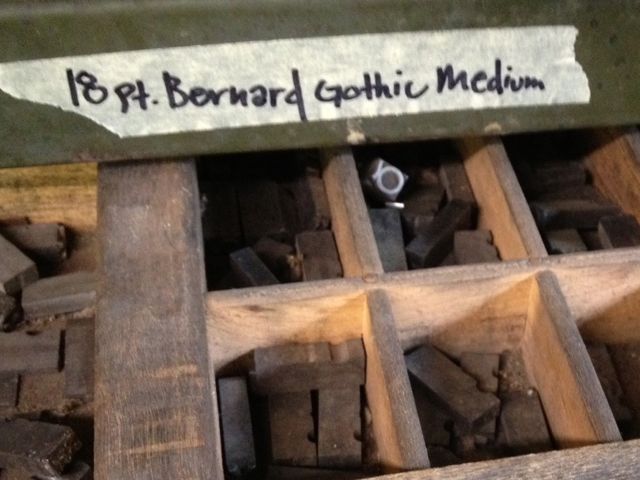
The salvaged Fairview cabinet, with its now barely noticeable bent frame (thanks to Tennessee’s infamously extreme weather which tried with all its might to wrap the behemoth around a tree trunk), fresh coat of paint that cured its cancerous rust, and masking tape that thoughtfully marks each of its drawers of typeface (i.e. “18 pt Bernard Gothic Medium”) has never been happier than it is now in its new home.
And then there’s the drawer marked “Mystery Type”. Unfortunately, a typeset is only of value if it is alphabetically complete. “No one wants to spend up to two hours putting together a whole poster or wedding announcement only to find that you’re missing the letter J,” explains Uhl. But unwilling to part with any homeless letter they come across, Uhl and Cheney toss hapless letters into the “Mystery Type” drawer. Uhl laments, “Who knows how many letters are still buried in the dirt in Fairview?”
The two artists are also unwilling to part with the remnants left behind by the two known previous inhabitants of the outbuilding who are yet posthumously adding character to the space: the previous homeowner, and his predecessor, a seemingly colorful character named Gaylord. Gaylord, who had outfitted the building with gobs of fishing paraphernalia, left behind a collection of Polaroid snapshots of himself holding his aquatic trophies. The previous owner of Cheney's house and garage - a man who used the space to refurbish and reupholster Volkswagen automobiles - held onto those photographs just as Cheney does now. Cheney also can’t quite let go of the random items such as a package of Black Cat Firecrackers and a very old tin capsule of fuses. He keeps these mementos in a box below one of the shop’s worktables, though he can’t say why.
But it must be because of Cheney’s and Uhl’s appreciation for the slow pace of bygone days; those artifacts that probably belonged to old Gaylord remind their handlers of a time when a printing press was high technology, and each project carefully worked upon it a labor of love. Uhl speaks passionately about her love for the slow, thoughtful process that, she believes, encourages her to be a better artist. “It takes a better designer to design by hand that frantically at a computer. There is something therapeutic about turning each letter over in your hands and even thinking about the person who made that individual letter.”
“High schools used to offer typesetting classes,” explains Uhl, “Now they just do everything on a computer. Computers are great, but the very fast lifestyle they’ve [birthed] goes too quickly for the human brain to pause and process. So, we miss things - things that you're only going to discover within a process.” She picks up a chunky rectangular block of dark metal and says, "This is my tab key!"
Even the logo Uhl and Cheney chose is a send up to the beauty of manual synergy - a two-person crosssaw like the one that hangs above the door of the little shop.
Sawtooth Printhouse operates almost entirely off the grid. Sure, they have electricity for their lights, box fan, and space heater, but Uhl points out that when it comes to her art, “I have to be the machine! No electricity necessary. This press is nothing without me, and I cannot achieve what I want without it.” A press doesn’t think for its operator the way we think of a computer doing; indeed, to even be necessary, a press is completely dependent upon a person.
Sawtooth Printhouse in located in Nashville, Tennessee. They are equipped and ready to complete jobs such as designing and printing custom wedding invitations, birth announcements, event posters, etc. Find them on Facebook at http://www.facebook.com/SawtoothPrinthouse, or view their website sawtoothprinthouse.com.
Sawtooth Printhouse Pays Tribute to the Old and Slow
Celebrating Made in America all week!

Celebrating Made in American all week!
True Love and Homegrown Tomatoes
 True Love and Homegrown Tomatoes
by Melissa Hawthorne, Gainesville Florida
It is summer in the South. I know this because this morning my son woke up, grabbed his fishing pole, and headed out the door (allowing the screen door to slam) to do some fishing at the old sinkhole. In the afternoon, after a brief rain shower, we decided the air was sufficiently cool enough to go blackberry picking and we happily stained our fingers purple. After, we swam in Grandma’s pool until the sun had set—the last rays of golden light basking over the freshly cut lawn while I distributed towels and decided that having berry cobbler for dinner is perfectly acceptable. It never really feels like summer until we have our first long, lazy day like this one.
But the other indicator that it is truly summertime in the South is the abundance of homegrown tomatoes that have been erupting from my garden. For the past few weeks I have been picking firm, red, heirloom tomatoes several times a day. What to do with this proliferation? Pico de gallo, bruschetta, and simple fresh slices are three of my favorite ways to serve these delicious fruits.
Grocers are beginning to catch on that consumers are willing to sacrifice tomato size for taste. Stores now offer vine-ripened tomatoes among the giant, sterile-tasting bowling-ball sized tomatoes on the produce shelves. But even the vine-ripened varieties cannot compare to the taste, feel, smell, or pride of a homegrown tomato.
The experience of buying a grocery store tomato pales in comparison to the long wait I must endure between seed-sowing and daily harvests, savoring not only the taste of each precious tomato, but delighting in their little scars and imperfections.
From preparing the beds to planting the starts, and then waiting, anticipating, watching and tending to the garden, obsessively guarding for caterpillars, and carefully removing them from the stems, checking on progress, making up excuses to walk past so I can check once more, weeding, watering, and then finding myself meditating while my hands are in the dirt and realizing that my mind is at ease and completely caught up in the present moment, free of any other worries or concerns, even if only for those few brief minutes, I gladly agonize.
When I bring my tomatoes inside and display them on the windowsill, or when I eat one, I am eating all of the care I put into the life of that tomato over the past three months. I am eating my husband’s care and my son’s care, our family’s shared time watching and tending and waiting for the ripening. I am experiencing the bees and the soft sunlight landing on the vine.
I recall Guy Clark’s memorable song that reminds us “there‘s only two things in this world that money can’t buy… true love, and homegrown tomatoes.”
Some things, like tomatoes or true love, really are worth waiting for. It is good to be reminded of this sometimes, in this instant-gratification world that we have somehow unwittingly created.
My tomatoes are ripe and it is officially summertime. But summer lasts a while and down here in the Deep South it gets too hot and sticky for things to last. Already my tomato vines show signs withering and wilting. When they have all laid down their little heads and given up their last bumper crop, I will turn them back into the earth and begin waiting for the spring.
I know it will be worth the wait.
True Love and Homegrown Tomatoes
People, Not Profits: Slow Food in Minneapolis
 People, Not Profits: Slow Food in Minneapolis
by Daniel DeWolf
In bucolic Minnesota, a farm-to-table restaurant using organically grown and produced food from self-sustaining farms might seem like an obvious concept. After all, over half of the state’s land acreage is used for farming. However, according to the United States Department of Agriculture, less than one percent of those farms are certified organic operations. Limited availability of these farms, coupled with the lower cost of using traditional food suppliers, might explain why fast food restaurants still outnumber their slow food counterparts here. But consumer conscientiousness about food and its origins appears to be changing—specifically in the Twin Cities, but on a national scale, too.
One example of this shift can be found in south Minneapolis, at Tangletown’s Wise Acre Eatery. Owners Scott Enres and Dean Engelmann opened the restaurant last summer to feed the growing trend. It also helps that they have a self-sustaining farm in Plato, MN, less than an hour away. The duo has owned the farm and Tangletown Gardens—which is located across the street from the restaurant—for over nine years.
“When we were originally looking for a perfect urban garden center location,” Endres says, “we realized we couldn’t have the acreage in the city to be able to produce our own materials, but we also realized that the kind of customer we wanted and connected with the most is in the city.”
That connection to their community is what makes this trio of businesses such a unique enterprise. The garden center sells items like plants and CSA (Community Supported Agriculture) shares that are grown at the farm; the restaurant’s menu features meats and produce that are raised responsibly and grown organically at Tangletown farm; and compost from the restaurant and the garden center are sent back to the farm and reintroduced into the earth.
“By doing it full circle, not having to import all that stuff, we save on cost and our carbon footprint can be lower,” Endres explains. “We’re not bringing in plants from Michigan or Utah; we’re bring in plants from Plato, forty minutes away.”
The farm also hosts a picnic and tour at the end of June and a dinner in late August, providing local residents a firsthand look at the operation, in addition to a meal made from scratch, using ingredients on site. The garden center and restaurant hold an art and garden tour at the end of July to raise money for community-oriented projects.
“That’s something that also helps build the sense of community around our businesses. We’re not just out there just to wait for the cash register to ring and to fill up on its own; we’re giving back, too. To build one of the strongest senses of community is when everybody can get involved and everyone can feel like they’re contributing something.”
Not all of the ingredients for the restaurant’s menu come from the farm, though. They reach out to Castle Rock Organic Farms for dairy products, and they stock their bar with craft beers from Fulton and Harriet breweries—both located in the Twin Cities—in order to support the local community.
“Trends come and go, and back in our grandparents’ days, this wasn’t really a trend, it was just the way that everybody ate. We want to serve this quality in our restaurant because it’s made with love and care.”
Endres emphasizes that the food served at the restaurant is “made with really good ingredients—local ingredients—that we can be really proud of serving, so it’s kind of like food with integrity.”
People, Not Profits: Slow Food in Minneapolis
Southern History at Carnton Plantation
 Southern History at Carnton Plantation
by Robin Fulcher, Spring Hill Tennessee
They say if you hold the railing all the way as you climb the petina concrete stairs leading into the graveyard you will see a ghost. How many times did I walk these steps, holding the railing all the way? The cold pipe would slide under my grip and as I walked into the green carpeted lawn with concrete growing and sprouting out of the ground. I would squeeze my eyes shut, hoping and praying that when I opened them I would see a figure from another time. I never did. I could smell the magnolias and fresh cut onions, see the dust in the rays of light, taste the sweat on my lips and feel the cold metal in my palm, but never once did I see the shadowy figures I longed for.
The caretakers of this plantation tell spine-tingling tales of sounds like heavy boots on the stairs, blood on the floor and porches and chilly, cold breezes on an otherwise humid, hot summer day in Franklin, TN. Carnton was a place of angels, not ghosts, to me. In the 70’s and 80’s, I grew up on these battlefields that became a part of Carnton Country Club. The trees in the lane leading up to the clubhouse have grown together to form a tunnel of lush greenery.
Oddly, this place would lighten my mood. It was as if all those boys and men that had died right on these grounds and were now buried in 1,493 unmarked graves, never to return to their families, seemed to become a part of mine. Perhaps this land, the field that hosted the bloodiest five-hours battle of the Civil War, has had enough perdition.
Carnton Plantation was built in 1826 and was home to the McGavock family. Its beautiful front yard became the venue for The Battle of Franklin at 4 P.M. on November 30, 1864. The home became the largest field hospital in the area and 6,500 souls left their bodies on the premises. You can visit and tour the home, gardens and gravesites today and even have your wedding there. It is a stately and elegant mansion that reminds me of a time when this country was trying to find its way. We aren’t there yet but take a tour and remember to close your eyes and hold the railing all the way.
Southern History at Carnton Plantation
Farms in Singapore: Jurong Frog Farm
 Farms in Singapore: Jurong Frog Farm
By Eunice Lim, Singapore
Singapore is a young country that lacks its own natural resources. Our busy city slickers are fuelled by foreign imported foods from all over the world, which we purchase from air-conditioned, sanitized supermarkets. Yet, northwest of Singapore, in an area called Kranji, a little countryside retreat is populated by various clusters of local farms. Although these farms are unable to provide the city with all the food it needs, they provide locals with a domestic option for fresh food. I visited the Kranji countryside as part of a commemoration of Slow Food Week and my first stop was the Jurong Frog Farm, a family business started in 1981 by Wan Bock Thiaw.
On the 20th of August 2008, the local newspaper The Straits Times published an article by Grace Chua that called on readers to not “let these amphibian species croak their last” (Chua). In her article, Grace states that “frogs world-wide are threatened by habitat loss, climate change, pollution and pesticides, over-collection as pets and food.” Frogs are also susceptible to diseases such as chytrid fungus. With the numbers of amphibians dwindling, the Jurong Frog Farm ensures their subsistence with healthy breeding practices. On top of that, they provide educational tours and workshops for both adult and children, giving them an opportunity to learn and interact with the American bullfrogs at the farm.
Instead of conventional tourism, the Jurong Frog Farm provides a new form of eco-tourism – frog tourism! Frog tourism is completed here with souvenirs and frog merchandise for sale at the Royal Frog Shop. You can purchase adorable frog badges, headbands and many more at the shop in support of the Jurong Frog Farm.
In addition to souvenirs, the Jurong Frog Farm sells its own produce - fresh whole bullfrog, frozen bullfrog legs, and specially selected snow jelly, or Hasma. Locally managed and sustained, the farm ensures top quality, fresh frog produce for Singaporeans. Low in fats, cholesterol and calories and high in protein, Vitamins A, B1, B12 and C, frog meat is also known to cure eczema and skin problems, neutralize heatiness and improve vitality.
The family’s youngest daughter, Chelsea Wan, joined her father in running the business in 2006. Still in her 20s, her youthful approach to running the business can be seen in the murals painted all over the Frog Farm. Calling herself a frog-o-logist (an expert in all things frog-related), she is also a member of the Kranji Countryside Association, a group of visionary farmers who aim to promote local agriculture and food production, conservation, and eco-tourism.
Amidst the croaks of the bullfrogs, the Jurong Frog Farm is an eye-opener for the city slicker. An entirely different side of Singapore does exist, a side that continues its determined and progressive fight for subsistence farming despite the rapidity and modernity of the city’s imports.
Farms in Singapore: Jurong Frog Farm
Local Food Just Makes Sense at Söntes
 Local Food Just Makes Sense at Söntes
by Nancy Yang, Rochester Minnesota
Us northerners have never much been known for our cooking, so saying that a restaurant in a small Minnesotan town boasts “local food” might not impress anyone. The customers won’t notice the extra effort the owners of Rochester, Minnesota’s tapas restaurant Söntes puts into their restaurant: coordinating up to 30 farmers, innovating dishes using constantly varying produce, and manipulating costs so that the prices are still competitive.
Tessa and Nelson started Söntes in 2006, and from the start the restaurant was fully committed to using local produce. Tessa says she had always intended to own such a restaurant. “I grew up here,” she says, and using farm produce was “normal as a kid.” When she moved to the Twin Cities, Minnesota’s metropolitan center, and saw all the local produce being shipped there, she asked, Why isn’t anyone in Rochester working with the farmers and using local products?
While many other Rochester eateries claim to incorporate local ingredients, none displays such an ardent commitment as Söntes. It emphasizes its seasonal menu based on locally grown produce and its support for not only the regional farmers but artisans as well. Söntes is decorated with works by local artists and houses live music on Saturday nights. Its blog is constantly updated with heart filled commentaries on food and wine, community news, and sustainable living. The Slow Food principle “just makes sense,” Tessa says, “We don’t know any different.” It’s obvious that Söntes goes above and beyond cooking local—they work with local. They honor the sense of community that Rochester urgently needs to remain vibrant and attractive for visitors.
Maybe it would have been easier to open Söntes in a large city, where transporting produce would be more efficient and the community would be more willing to recognize Söntes’s undertaking. “It’s not always a money maker—the products are more expensive and is a big deterrent for people, and it’s very hard to implement and execute.” But Tessa and Nelson chose Rochester, and their restaurant is thriving.
At the downtown festival, I have to wait out a long line running from Söntes’ stand, so that I can grab a bite of their paella. It’s being cooked in an open-air pan almost as wide as I am tall, and it smells heavenly. Clearly the numerous customers believe Söntes's slow food is worth the wait.
Local Food Just Makes Sense at Söntes
Careful Eating in a Food Paradise
 Careful Eating in a Food Paradise
By Eunice Lim, Singapore
 Table at 7, SFCSS’s dining venue on the 19th of November 2011“Eat more carefully and do not finish what you do not like.” – Mr. Jen Shek Voon, Founder Chairman of the Slow Food Convivium Society (Singapore)
Singapore has a diverse range of food and is often referred to as the “Food Paradise”. Numerous visitors all over the world come to Singapore, eager to have their taste buds tickled by the exotic delicacies available. Hawker centres, coffee shops, restaurants and fast food franchises will have you spoilt for choices. There is so much food waiting to be devoured. But Mr. Jen Shek Voon, founder chairman of the Slow Food Convivium Society of Singapore (SFCSS), advises that we are to “eat more carefully and not finish what we do not like.” Rather than promote wasteful eating, Mr. Jen is devoted to the slow food movement, which encourages careful consideration and knowledge of the food on the table, before actually putting it into your mouth. Good food is not only about food that is delicious, but also about responsible eating in the presence of good company. 
When I interviewed Mr. Jen on behalf of Robin Wade Furniture, he defined Slow Food as an enjoyment of the slowness of time and the gaining of insight into the food on the table, for example how it is prepared. He also defined it as an exploration of the realm of the senses, in which the cuisine appeals to him and the wine that is selected to be paired with it. His definition rejects mindless wolfing down of food in record time and encourages us to indulge in the art of food and allow ourselves the time to establish a relationship with the food we eat. After all, you are what you eat. If a food is disagreeable for one reason or another, eating it would mean one eats for the sake of eating, and that alone is not sufficient reason to let the food become part of your body. What makes the SFCSS so special to Mr. Jen is the camaraderie that binds their members and friends together, a camaraderie that is connected to their sense of taste and enjoyment of all good food and wines. The SFCSS hosts a lunch for its members every last Saturday of the month. Not only are the meals they share memorable, but are carried out in the company of like-minded people.

When asked to reveal what could be expected in the next lunch gathering, Mr. Jen replies that the proof of the pudding is in the eating. Members pay an annual subscription fee of $120 Singapore dollars, of which S$100 goes to the International Office in Bra, Italy, for the payment of dues and the subscription of 3 issues per year of the Slow Food International magazine. Additionally, at the standard price of $150 Singapore dollars for the monthly meal, being part of the slow food movement here in Singapore does come with a rather hefty price and may not be for those on a budget. Even though you could buy 30 Happy Meals with $150 in Singapore, this monthly meal guarantees happiness too, albeit of a different sort. Instead of speed and instant gratification, the SFCSS invites you to immerse and indulge in the slow satisfaction of a quality meal, accompanied by merry laughter and conversation.
There is peace in knowing that the food on the table comes from clean and ethical sources. There is solace in knowing that in this fast food era, there is the Slow Food Movement to remind us of what it means to slow down our footsteps and appreciate the food we eat. Finally, it is the comfort of knowing these things that make the monetary price worth the paying.
Photographs and Pictures taken from Slow Food Singapore’s Facebook Page with the permission of SFCSS.
Slow Movement in Fast Singapore
 Photography Courtesy of Juliana LimSlow Movement in Fast Singapore
By Eunice Lim, Singapore
“Our senses can only take flight upon deceleration. Accelerating life simply numbs your senses. And to live without all those senses is hardly living.”
In the year 2007, Cable News Network (CNN) published an article online about a research by The British Council that identified Singaporeans as the fastest walkers of the world. The research was carried out in 32 cities including London and New York. For a small city of a mere 274 square miles, its citizens took an average time of 10.55 seconds to cover a distance of 60 feet. With astonishing statistics like these, the negative consequences of a fast city are gradually dawning upon Singaporeans. Attempts to relinquish the fast-paced rat-race lives we are used to have resulted in yoga classes mushrooming all over the city and increasingly exorbitant massage sessions, all of which are carried out, unsurprisingly, at top speed. Slow living in such a 
From 18th May to 2nd June, Umbrella for 2 by Espaces Sonores graced the Singapore Arts Festival 2012. An in-situ reality “soundwalk” by the sound scape director Stéphane Marin from France, an Umbrella For 2 consisted of two participants sharing a large black umbrella and an mp3 playing synchronized tracks of sounds and a meticulous mish mash of opinions on the city. The walk challenged the lightning pace of the fast city by taking the participants on a 60-minute long walk through the city.
The walk combined the aesthetic experiences of reality with audio enhancements, boldly challenging our ability to see our own city for what it really is amidst our usual hustle-bustle. At some point, the walk is purposefully planned in a way that causes the participating duo to advance towards a train station’s exit gantry, inevitably hindering exiting commuters. Visibly annoyed, commuters unaware of the Umbrella for 2 dodged and shoved the duo, who momentarily found themselves trapped awkwardly in the city’s unrelenting, unstoppable human traffic. Simultaneously and almost mockingly, the synchronized track played voices uttering frantic apologies. In that carefully engineered moment, the raw realities of our fast-walking city are exposed.
 photo credit; “An Umbrella for 2” Facebook PageQuite unapologetically, the fast walkers of Singapore are ready to jostle their way into oblivion, not once stopping to question the curious sight of a duo holding a giant umbrella indoors. The fast food culture has accelerated our lives into a succession of flitting images, blurring the various experiences into an indistinguishable mess. An Umbrella for 2 acknowledges and seeks to make sense of the mess through a slow walk, highlighting the sights and sounds Singaporeans have otherwise, been blind and deaf too. Singapore’s lack of four seasons was also pointed out to explain the Singaporean’s inability to perceive our weather and environmental changes. Communal Kampongs replaced by the cold, columbarium-like high-rise flats are pointed out as a possible cause of loneliness. The repeated emphasis on consumerism and the social and environmental price paid for these economic developments serve as an awakening for the Singaporean to embrace slow living.
Although conducted publicly, the Umbrella for 2 was a private and unique experience for each individual. Refreshingly perceptive, the one hour of slow movement reshapes the Singaporean by giving him the chance to savor the sensory experience of slow living. After all, our senses can only take flight upon deceleration. Accelerating life simply numbs your senses. And to live without all those senses is hardly living.
natural edge oak desk
 natural edge oak desk
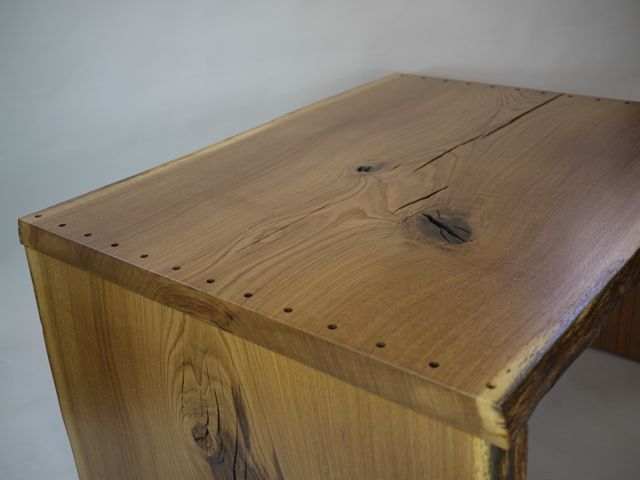
This natural edge oak desk also arrived fresh out finishing room this morning. This one's a real beauty, flaunting nothing but natural throughout. The
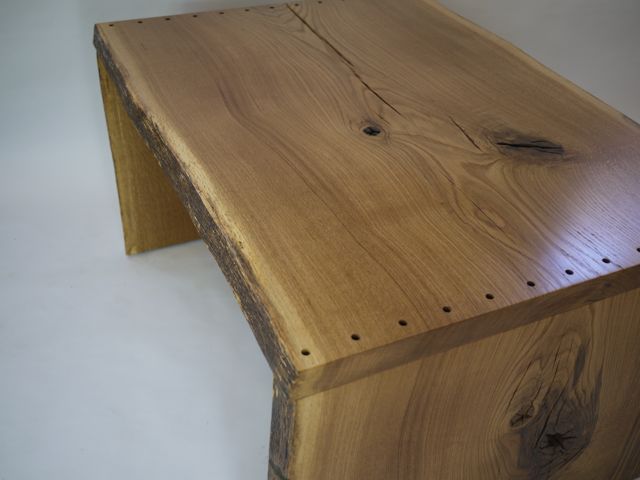
beautiful natural edges of the local oak tree are clearly apparent from leg to leg. Another - somewhat natural element is the fairly common "blue streak" down one leg. So many of our larger oak trees spent their previous
lives shading a residence. And, as we human types seem to have to do, metal of all sorts seems to find its way into the back yard trees. This blue streak is a flag to our sawyers milling the logs to be careful - that there is metal close by (usually just above the metal stain).
Just another unique, one of a kind
somewhat natural table.
38" x 58" x 30" tall
natural edge oak desk
low oak coffee table
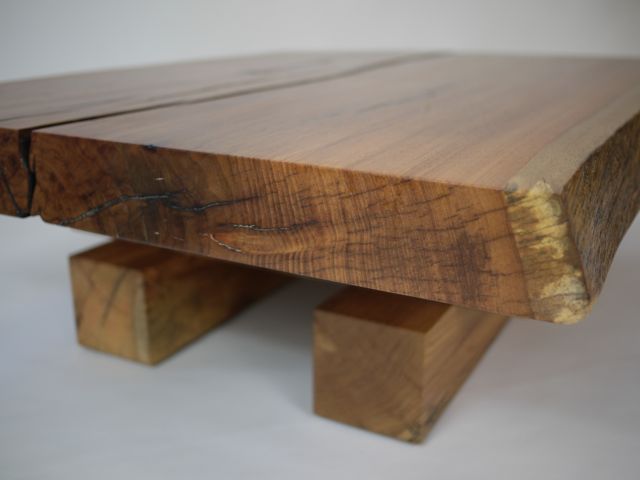
Right out of the finishing room is this low oak coffee table. Very much like slow food, much thought and time and attention went into this thick, heavy, modern natural edge table. And nature left a beautiful signature cracked throughout the top.
low oak coffee table

Imagine a World where the food we eat . . .
Imagine a World where the food we eat . .
Imagine a World where the food we eat . .
by Robin Fulcher, Spring Hill Tennessee
Imagine a world where the food we eat is as healthy and good for our body and planet as it is for the people who produce it. This is the vision and mission behind Slow Food. An atavistic return to agricultural life with awareness and responsibility is a thirst I think we all have deep down. Food is something we all have in common. It nourishes, comforts, sustains and provides. We borrow this earth from our children and grandchildren. Today, less than 30 plants provide 95% of the world’s nutrition. In the past century, 250,000 plant species have gone extinct. Carlo Petrini started the Slow Food Movement in 1986 and said, “It is useless to force the rhythms of life. The art of living is about learning how to give time to each and every thing.” Slow food is the intersection between ethics and pleasure, ecology and gastronomy. It is the opposite of fast food.
Even at Whole Foods the apple that is on the shelf is, on average, 14 months old and has been picked premature, held and then gassed to turn red. Instead, perhaps you can try your local farmer’s market.
When I graduated from Le Cordon Bleu, I was disgusted with most of the knowledge I had gained on the food industry. The things that are added to preserve color and add taste are repugnant. I was told, by my professors, I would never want to eat out in a restaurant again. Prophecy fulfilled, in my case. Food unites us with all living things. There is a respect that should be given to the plants, animals, farmers, cooks and diners. We all deserve it. Good, clean and fair are the ideals we should strive for, not fast and cheap. Let’s face it, the world’s food system is broken! What is farmed = what is eaten = processed food here in America.
Across the world, 1 billion are hungry and 1 billion are obese. Let’s work together towards system change. Vote with your fork!
Imagine a World where the food we eat . . .
Local, Sustainable, Beneficial
 Local, Sustainable, Beneficial
By Claire Davidson, St Paul Minnesota
Much like Robin’s belief in American-made products, obtaining your food from local growers and farmers’ markets is equally essential to “living the green life.” Aside from being eco-friendly, purchasing American-made furniture and locally grown produce are both practices that promote economic growth and sustainability. In today’s economic climate, there is nothing more important than buying locally.
I live in Minneapolis, where I am fortunate enough to be surrounded by socially conscious, organic food suppliers. Local cooperatives like The Wedge, which became the state’s first certified organic retailer in 1974, have consistently bought from local farmers to supply fresh and organic products directly to the consumer. Having enjoyed over forty years of success in a highly metropolitan area, The Wedge is proof that sustainable food practices matter just as much to the urban city dweller as they do to the small-town farmer.
Whether you’re purchasing what will become your family’s next meal, or a great new piece of American-made furniture from Robin Wade, here are some tips on how to get the most out of buying local:
Be Patient
So much of our busy lives today revolves around how quickly we can get our needs met, but we often don’t stop to assess how well these needs are being addressed. Sure, your stomach’s growling and you need a quick fix, and fast food sounds increasingly appealing the hungrier you get. But to truly satisfy your body’s need for fuel, you have to supply it with the proper nutrients. Simply taking the time to prepare your meal from fresh ingredients is one of the first steps to having a better diet. If you take a little extra time, you can visit a local farmer’s market and obtain fresh vegetables for a salad you prepare later that day. Sure, it takes a little extra, but ultimately this process is more rewarding. Similarly, at Robin Wade, large slabs of wood are sometimes given years to dry to ensure the finest quality and best product for the consumer. The more appreciation you have for the process, the more you can enjoy the final product.
Take Only What You Need
With many families buying in bulk from mass retailers, the problem of overconsumption is spreading rapidly. If you buy local, fresh food from your neighborhood co-op you are less likely to over-purchase, which leads to less waste. How many times have you simply bought too much of something, only to see what remains get tossed in the trash? As stewards of this planet, we owe it to ourselves to be more aware of how much we are purchasing, how much we are consuming, and how much we are wasting. This is why it is essential to buy only what you truly need and will consume. Similarly, at Robin Wade the belief is that our forests should not be aimlessly cut down to mass-produce furniture and contribute to the problem of overconsumption. As a sustainable company, the goal is to only take what is necessary. Felled trees are saved from the landfill and turned into meaningful works of sustainable design.
Know That You’re Contributing to Local/Small Business
Perhaps the best thing about buying locally is that it benefits both the environment and the economy. As Americans, more and more we must see these two linked together if we want to create sustainable, eco-friendly and economically beneficial practices. To find a farmer’s market in your area you can visit the USDA’s website and enter in your zip code at the bottom of the page:
Local, Sustainable, Beneficial
The Spiral Diner - a Slow Business Model
 The Spiral Diner - a Slow Business Model
by Tony Lothes, Dallas Texas
Spiral Diner is part of a brave new movement in modern culture. That movement has been referred to as a sustainable world, a world that is conscious of its actions and how it affect the world around them as well as the future. Spiral Diner is a complete vegan restaurant, getting its start as a humble food cart in the Fort Worth Rail Market with a staff of only four people. They serve only foods that are brought in from local farms and use cooking methods that promote a healthy lifestyle. Spiral was a quick hit with everyone around the Fort Worth Rail Market, gaining patrons hungry for their exquisite cuisine and friendly service. Spiral was the brainchild of Amy McNutt, a visionary young woman whom, after graduating from film school, was making a documentary on the cattle industry. While working on her film, she encountered some secrets that changed the way she looked at food. It also changed the way she saw the world and how we use our everyday resources. After reading a story called “The Little Pencil” she realized how much of the world and our actions are violent, in more than just the physical human-on-human sense. The story makes reference to the ways violence is poured on society and how we perpetuate it. When we throw away clothes or half used items, that is, in its own way, violence against humanity itself. Inspired by these stories and projects, she made a career-changing decision and moved back home to the heart of cowtown to open a vegan restaurant.
Spiral Diner offers a widely varied menu ranging from smoothies to spaghetti and meatballs. All foods are one hundred percent vegan and are made mostly in house, from scratch. Spiral is priced very affordably-- clearly stating that it is not their intention to make money off their clientele, but to provide the community an affordable option when it come to a vegan diet as well as gainfully compensating its staff for their efforts.
Spiral is committed to showing the metroplex that veganism is not only a smart choice for its people's health, but it’s the smart choice for the environment. The livestock industry has been linked to the deaths of countless aquatic life in the Gulf of Mexico due to waste runoff, as well as heart disease, cancer and arthritis. Spiral’s message is clear: veganism is the best choice for the good of our planet.
The Spiral Diner - a Slow Business Model
Slow Food: The Art of Canning
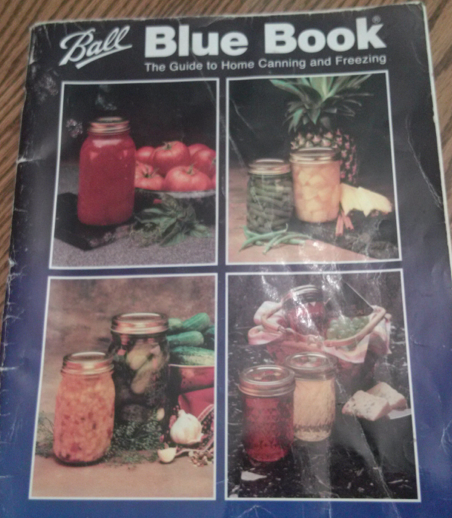
Slow Food: The Art of Canning
by Jessica Bender, Cunningham Tennessee
I am going to be honest with you: when I heard about Slow Food Week, I had to Google Slow Food. I had no idea what I was supposed to be writing on, but once I looked it up I was surprised to learn that my love for food and love for cooking have come from the Slow Food Movement. I guess I didn’t realize that what I had been taught about food was part of a movement taken up by thousands of people. To my surprise, canning foods is one of the techniques that Slow Foodies use.
When I was growing up, I thought for the longest time that everyone’s mom canned beans, potatoes, and jams. It took me a while to figure out that not everyone knows this skill. It seems to have turned into a tradition that some people think archaic, or even prehistoric if you tend to exaggerate. I am in awe of my mom every time she cans. She takes yummy, fresh veggies and turns them into something that we can use at any time of the year. It really is amazing. I decided that my Slow Food Week submission would be an interview I gave my mom on the art of canning.
Q: “Now mom, are you aware that pressure canning food is one of the aspects of the Slow Food Movement?” Before she answered, I explained to her the basics of the SFM, such as choosing seasonal and locally grown produce, and preserving it rather than purchasing in the off-season.
“No. I had no idea that canning would be part of something like this. It is also nice to see that so many people are choosing to eat this way. Everyone may not choose to can, but eating local is very important.”
Q: “There is such a high demand for the canning skill that, in some areas of the country, there are workshops to teach it. How do you feel about this? Do you feel that this should be a traditional skill that most people should learn? Why?”
“I think that the classes are a good idea. Most people who learn this are learning from their mothers and grandmothers. For the people that do not have a family member to teach this, then the classes are a great way to bring the tradition alive again so that the students of today can be the teachers of tomorrow.”
Q: “Why do you think that canning/pressure canning food is such an important thing to do?” “First, there are two techniques that people can use to preserve their food. There is pressure canning and water bathing.
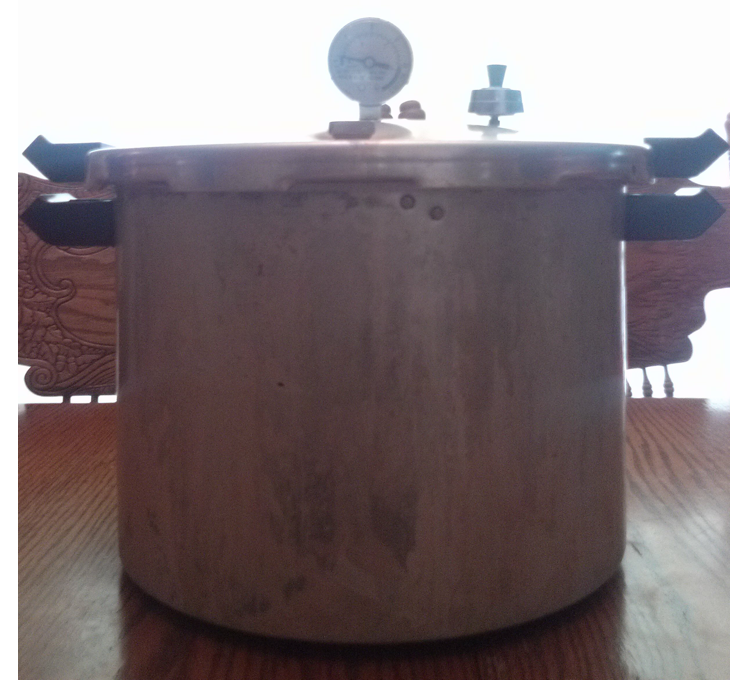
“Pressure canning is what most people think of when they hear the phrase ‘canning food’. This is also my favorite technique to use. Pressure canning is where you put a certain amount of salt and water into a jar with the desired food to be “canned”, and then seal them. The pressure canner itself is filled with water so that the jars’ seals are submerged. As the pressure canner is heated on the stove, steam escapes through the funnel. Once it is steaming, you place a weight on that is made for the canner to allow pressure to build to the desired amount of poundage per square inch within the canner. Throughout this entire process, you are following a recipe that tells you how much salt, water, pressure and how long to apply the pressure. It will come naturally after a time, but the recipe book for canning is always something to have. Once the jars have been cooking at the pressure specified by the recipe, then you let everything cool to zero pounds per square inch. Lastly, take off the canner’s lid and remove the jars to a draft-free place for up to 12 hours. Be sure to check the seals to make sure that they did in fact seal. If they did not, the food must either be used right away or you’ll have to process the food again with a different seal. This can result from too much water in the canner, not enough, or defective seals.
“Water bathing is used for the preserving of acidic foods and foods with high sugar content, such as jams and jellies. In this technique, food is prepared following a special recipe from the canning cookbook and is placed in the water bather’s wire rack. The wire rack within keeps the jars from hitting each other when the water boils. When you add water, the water must cover the jars by at least two inches. You place the jars in the wire rack and bring everything to a boil. Once boiling, you have specific times for different things as to how long they should boil. After time is up - let them cool, take them out and allow them to sit for 12 hours as you would with pressure canned foods. This is the easier process of the two. I use it to preserve things like pickles and tomato-based sauces, along with jams and jellies.”
Q: “How did you learn this amazing skill? What was your first canning experience?”
“I learned to do this from my mother, who in turn learned to do it from her mother. This is somewhat of a family tradition for us.
“I was 11 or 12 when I had my first canning experience. It was when I assisted my mom in canning a bushel of green beans. I was given the very important task of washing them. I can remember that it felt like it took forever, but maybe that was just me being 11. But what I remember the most is when she opened a jar of the green beans that I had helped her with. I was so excited when I tasted them and they tasted surprisingly fresh. From that point on, I knew I wanted to can. Everything that we ever canned together was amazing and without all the preservatives that canned foods from the supermarket had. So fresh.”
Q: “What supplies do you need to begin canning?”
“First, you obviously need a pressure canner. You will also need canning jars, seals and lids to accompany the jars, special tongs, jar lifter, plastic stick spatula, and a seal checker. Water bathing takes a large, special stock pot with a wire basket that keeps the jars separated.
“What is so great about canning is that once you invest in the canning products, such as the jars, lids, and pressure canner, they will last forever. As long as you have extra jars to accommodate your habit, then you are set. The seals are tricky and need replacing every time you can, but other than that this is a very budget-friendly skill. When you consider the upstart cost, it is no comparison to the money you will save on groceries and the good food that your family will have at their convenience.
“I have personally been collecting jars since I started and I have used the same pressure canner for twenty years.”
Q: “Do you buy local, sustainable produce for your adventures in canning? Why?”
“Yes I do, as often as I am able. I love to give back to the local farmers. I also find that local stuff is fresher that whatever they are selling in the supermarket. I have built a great relationship with my produce dealers. It is important to keep our community tight and supporting itself.”
Q: “Any tips on stocking pantry shelves?”
“The most important thing to stocking your pantry with canned foods is to determine what your family will use the most. You need to make sure that you can get things as fresh as possible, when the season comes, and can like there is no tomorrow. I always have potatoes of any kind ready for stews, mashed potatoes, roasted potatoes, and they even work for frying. I can carrots for my stews as well; these beauties are great with a balsamic glaze and a little brown sugar too. I also just started making seasoned tomato sauces for chili.”
As I get older and raise a family of my own, I begin to really see my mom as a different person. She is resourceful and amazing. I knew this all along, but now I want to learn her ways. I have started to really appreciate some of the traditional things that my mom does. I want to learn to hand quilt and can, just like she does. I have been busy every summer since I have started college and raising a family, but I have decided that this summer is going to be it. I have gotten a feeling for how I run my own household and how I like to stock my food supply. Canning is one way to cut out an exponential amount of preservatives that I am so desperately trying to get away from. I have learned from my mom that fresh doesn’t have to mean straight from the farmer’s food stand, but can also mean something from a wide mouth Mason - canned last summer. It tastes great and just as fresh as the day we bought it from Mr. Parker (her produce man).
Mason jars have a much different meaning to those who know the art that is canning. They are not only for drinking a nice cold beer or sweet iced tea out of; they are the best receptacle for amazing farm-fresh fruits and veggies to be had at any time of the year, thanks to the age-old skill of canning foods. I wish the newcomers good luck in their journeys through the world of canning and also some to myself. I do have a family tradition to uphold and all in this art of canning.
Slow Food: The Art of Canning
Slow Food Week - Making a Difference?
 Slow Food Week - Making a Difference
by Amanda Eberhart, Clarksville Tennessee
June 12, 2012
In a fast-paced world full of deadline-driven people, it can be difficult to find the time to properly take care of yourself. Just thinking about our nutritional needs on top of our daily rituals seems exhausting. And when you're hungry and on a time crunch, it's very easy to fall victim to fast food, processed food, or both. It seems that our daily demands have rendered people too tired to think through and execute a well-planned meal, let alone a meal that sustains organic properties, good for both our body and the environment. But what people fail to understand is that in an effort to take care of ourselves by these "easy" means, we are overlooking how the choices that we make affect not just ourselves, but the environment and our world as well. So it's time to get educated on the problems at hand and the forthcoming solutions, and how you, individually, can help. These are the principles that the annual Slow Food Week celebrates June 18th through the 24th this year.
All it takes is the difference of one individual at the start:
In 1986, Carlo Petrini decided to take a stand against the over-industrializing of our food and achieved a recognition that sparked a movement throughout the world. In doing so, Petrini became the founding father of a small association called Slow Food, a movement that aims to demonstrate how food impacts our state of wellbeing and our environment. Petrini realized that our food traditions were waning and that people were growing more uneducated concerning how our plates and our planet are connected. This movement stands to counter the ever-rising fast food trend by offering alternatives to our over-processed plates. It also supports the workers who are responsible for producing the foods we eat, putting local farmers and artisans on an important pedestal. In the present day, what started as a small association of Italian origin has gained momentum and now boasts over 100,000 Slow Food members. These members are found throughout the world in over 150 countries and are dedicated to spreading this education even further, both by word and action.
In working towards combating how fast food and processed foods are standardizing tastes, the term 'Slow Food' alludes to the exact antonym of the term 'Fast Food'. From the growing and cultivating process, through the harvesting and selling process, nothing about this movement suggests industrialized, processed, or lightning speed. The Slow Food Movement is looking to emphasize the vital role that local agriculture, crops, and livestock play in our environment; the 100,000+ people taking action in this movement are reiterating to consumers the importance of sustainable foods; small, locally-based businesses; and regional agricultural products. The industrialization of these three main aspects has brought on the elimination of thousands of flavors and options for different pairings of food. Culture is being forgotten, wellness is taking a back seat, and, sadly, the means the industry uses in producing the products that we consume have toxic effects on our environment. These priceless elements need to take precedent over what is "quick and easy", especially if we are going to see a major difference in our health and the state of our planet.
So how is Slow Food making a difference in the United States exactly? The world doesn't seem to be slowing down and the economy markets these organic products at a rate that is outside of the average person's budget. Slow Food USA online stands to combat both of these issues and also shares their objectives and their vision through this passage on their website: "Slow Food USA is a national non-profit that believes in a world where food and farming are sources of health and pleasure for everyone. Organized into local chapters nationwide, our supporters, members and chapter leaders raise awareness through local projects, national advocacy campaigns and education, and seek to provide people with a pathway to make a difference in the sustainable food movement. From building a school garden to joining a campaign to make it easier to afford and access real food, Slow Food staff, members and supporters are reshaping the story of food and farming in America."
In addition, here are some highlighted examples of how Slow Food Week is catching on throughout America: “Ironically, Slow Food has proved remarkably successful in the United States. Popular authors Michael Pollan (The Omnivore’s Dilemma) and Eric Schlosser (Fast Food Nation), as well as celebrity chef Alice Waters, have helped the Slow Food USA membership grow into the tens of thousands.
In 2008, Waters founded the inaugural Slow Food Nation event in San Francisco. The city welcomed the event with open arms, with Mayor Gavin Newsom encouraging the organization to replace part of the city hall lawn with a vegetable garden. The event featured a speech by Petrini, panels participated in by Pollan and Schlosser, a marketplace and food tastings, and other events. More than 50,000 people attended.
In the United States, Slow Food has been involved in post-Katrina New Orleans as well, with members raising money and devoting time and energy to help restaurants reopen.”
So how do you get involved on a small scale, when you’re not a celebrity chef, an author, or someone who knows about these things? Look into your region’s movement further via any means of research; you may discover that there are many local associations and sponsors in your own backyard that provide farmers’ markets, wine tastings from local vineyards, and Taste Workshops or community celebrations involving regional specialties. It doesn’t take any special knowhow to find these events, just a search engine and a few key words. Try to incorporate the name of your town, your zip code, and other words referencing fairs, markets, festivals, local organic food, etc. You’ll be surprised by what’s happening in your hometown that you may not have known about. And then take the next step.
If you don’t want to get involved in a local chapter or donate without giving the principles of this movement a try, start by going out of your way to shop at local vendors and farmers’ markets. If nothing else, you are putting your hard earned money back into the local economy, supporting agriculture and farming jobs instead of feeding the fortune five hundred companies that are selling you “organic” products at sky-high prices. You’ll be paying about half the price for these products, too. On top of that, you know exactly where the products come from, and if you engage the seller, who is, nine times out of ten, the person responsible for the farm itself, you can find out how they take care of their crops, livestock, fruits and vegetables, etc. Then, start finding recipes to incorporate your locally bought goods. Again, search engines are your friend when it comes to this, and it does not need to be too complex or time consuming. A better eating regimen, a better educated outlook on how to take care of yourself and Mother Earth; the possibilities are endless if more people take notice and jump on board.
So, in light of Slow Food Week, I urge you to take a stand and get out into your community. You never know when your next favorite spot will be discovered, what your next delicious meal will be composed of, and how you, taking the time to make a difference, will contribute to making sure we still have a world to pass on to the generations to come.
Slow Food Week - Making a Difference
Slow Food Dallas
 Slow Food Dallas
by Veronica Rushing, Lewisville Texas
Slow food week in Dallas has arrived. This week you will be introduced to a diverse, organic way of eating and a cultural lifestyle that’s guaranteed to get your mind working on ways you can incorporate these changes into your every routine.
In 1986, Carlo Petrini started an international movement which promoted the idea of traditional and regional cuisines across the nation. In attempt to provide families with an alternative to fast food, Petrini’s movement encouraged the farming of plants, seeds and livestock characteristic of the local eco system. This movement had an exceptional growth experience across the globe affecting not only individuals but also small businesses.
In the Dallas region there is a wide range of Slow Food restaurants and cuisines fit to please any and everyone’s palate.
Looking for Barbecue? Then Sonny Bryan’s Smokehouse is definitely for you. With locations in Richardson, Irving, and Dallas, Sonny Bryan’s Smokehouse offers nothing but choice smoke meats which includes fall-off-the-bone rib baskets, delectable turkey, mouth-watering sausage, and irresistible pulled pork sandwiches. Their finger-licking tangy barbecue sauce will have you wanting to go back for seconds, and maybe even thirds.
Avila’s Mexican Restaurant in Dallas has been producing many traditional favorites for the last 25 years. Upon arrival, savory salsa is delivered to your table with tortilla chips made from scratch. Since Anita Avila’s dishes consist of the freshest and most delicious ingredients, you will probably have a hard time choosing the right dish for you. Selections include brisket tacos, chiles rellenos, and customary mole that will create a flavorful experience for your taste buds.
Hattie’s, located on Bishop Street in Dallas, is where you need to be if you are looking for the perfect Southern dish. This just what the doctor ordered-- bistro and southern hospitality makes for a comfy experience. All year, Hattie’s menu offers a three-artisanal-cheeses macaroni that you must have before leaving this restaurant. Depending on the season, you might find fried-green tomatoes on the menu, shrimp over goat cheese grits with Tabasco-bacon pan gravy, or pulled pork in a sweet onion sauce.
Other Slow Food cuisines include Naan Sushi, located at the intersection of Bishop and Legacy in Plano, and You Chun at 2254 Royal Lane in Dallas will satisfy the Korean appetite. For a feel of Venezuelan you would want to try Zaguan Bakery and Café at the intersection of Oak Lawn and Routh in Dallas.
Slow Food Dallas
Slow Food: Making a Difference, One Voice at a Time


Slow Food: Making a Difference, One Voice at a Time
by Tanya Wardell, Fort Worth Texas
There’s a change happening in the United States. A new voice soaring up through the crowds, growing stronger and louder with each passing second. A voice, rising in protest against a lifestyle driven by constant demand and fast paced everything. A voice whose words are more than just letters put together, but instead are made up of actions. Actions taken by people like you and me, who are tired of living a life where our bodies and minds suffer from five-minute meals made up more of chemicals than food. People who are fed up with a fast food industry whose big business practices squash real appreciation for taste and quality. People who believe that we have the right to eat and enjoy healthy, natural food regardless of where we live or how much money we make.
This voice believes in the “little man”, the “underdog”, the farmers who work hard every day not only in the fields, but against the threats of those industrial farms who would rather swallow them up than allow them to provide real, healthy, good food to their communities. It believes in slowing down, appreciating what we have, savoring every moment as if we are children discovering the world for the first time.
The voice rising above the fray is the Slow Food movement, a global celebration of food and community. Its motto? Everyone deserves access to “good, clean, and fair” food. Its mission? Defend this right. Free us from the oppression of the fast food industry. Remind us that we are powerful, we are capable, we can make this world a better place. As we celebrate this Slow Food week together, let us remember the motto and mission, let us know that we are not simply eating wonderful meals. We are finding our voice. We are declaring our rights, announcing our freedoms. We are making a difference.
Slow Food: Making a Difference, One Voice at a Time