

Veggie Thursdays!
by Richard Harris, Brussels
The open air market on Saint-Gilles church square has been operating for centuries starting when Saint-Gilles was a small village on a hillside overlooking Brussels. The fields around the village are where people first started cultivating Brussels sprouts over 600 years ago taking advantage of the many natural springs that flowed down the hill. Now Saint-Gilles is one of the 19 boroughs that make up Brussels and it's a lively mix of different ethnicities and nationalities living in handsome Art Nouveau and Art Deco neighborhoods. As well as the age-old Sunday morning market there are morning markets four other days a week, though they tend to offer more dry goods than food. The Sunday morning market is the classic food market with everything from a fishmonger to a guy who sells nothing but potatoes. In between there are fowl merchants, butchers, vegetable stands, fruit stands, cold cuts and cheese stands, olive sellers, bakers, wine merchants etc. Last year a gourmet/organic evening market was created on Thursday evenings and it's a big success with quite a few prepared food stands and organic beer and wine merchants. The whole square becomes one big café terrace filled with animated conversations as everyone relaxes after a day's work.
EVA (Ethical Vegetarian Alternatives) is a Belgian organization which promotes vegetarian eating through a number of different actions - information stands, conferences, cooking classes, their website, and special events. They promote Veggie Thursdays to get people to eat vegetarian at least one day a week. As they tell it, if a person has one meatless day per week that person will eat 250 less animals during his/her lifetime. And since it takes 22 pounds of grain and 4,000 gallons of water to produce 2 pounds of beef and also since livestock raising contributes one fifth of greenhouse gasses, everyone doing a meatless day will help appreciably to lower the world's carbon footprint. Which brings us to today's event. EVA decided to take advantage of the popularity of the Saint-Gilles Thursday evening market and set up what they claim is the longest vegetarian table ever in Belgium for a Veggie Afternoon/Evening.
The food was phenomenal and everyone had a fabulous time.
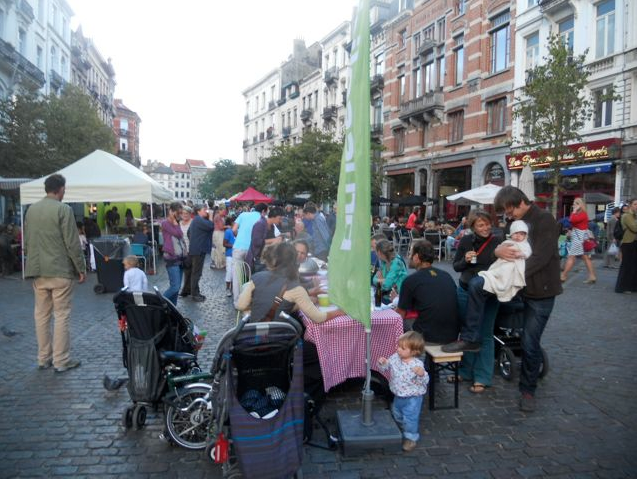
Veggie Thursdays in Brussels

open air market on Saint-Gilles church square
Ben Zeitlin, Beasts of the Southern Wild
I want to fill my life and my films with wild, brave, good-hearted people. Whatever amount of chaos and disaster that leads to doesn't matter, because you're going through it with the people you love, and in the end, no matter what, the movies come out wild, brave, and good-hearted. Ben Zeitlin
Sounds like a pretty good furniture company mantra to me. It's not showing here yet, but I can't wait.. Cannes and Sundance love it. I'm pretty sure I'm going to. Let me know if it's showing anywhere around here.

Ben Zeitlin
The Greenest Event - Johannesburg
I just ran across this video of the Greenest Event which was held earlier this month in Johannesburg. What an amazing meeting of environmental minds - in South Africa.
the Regenerative House

the regenerative house - portland
by Brendan Thompson, Pacific Grove California
In Portland, Oregon I had the pleasure of helping Scott Howard and his capable crew build an earth bag house. Scott has been a creative builder for most of his life, and is dedicated to bringing more ecological and affordable housing into existence. In 2002 he founded Earthen Hand Natural Building to educate people through hands-on construction workshops. Over the past decade the Earthen Hand team has traveled to Thailand, Jamaica, Mali, and Puerto Rico, teaching and learning from the locals.
Scott's
latest project is the Regenerative House, a modular open-source design
that is extremely cost effective, easy to build and environmentally
friendly. The philosophy behind the Regenerative House aligns with that
of the Living Building Challenge, a competition which recently won the
Buckminster Fuller Challenge “...the highest
possible level of environmental performance, envisioning a built
environment that is fully integrated with its ecosystem. It pushes the
building industry to re-imagine business as usual, and it transforms
building occupants from passive consumers into active stewards of
increasingly scarce resources.”
The
Earthen hand team held a building workshop July 14-31, to create a
prototype of this groundbreaking blend of ancient and modern technique.
The building will be sited at the Wirikutu Peace Fellowship in southern
Colorado, future site of a Shambala Buddhist retreat and ecovillage.
The home achieves its remarkable self-sufficiency through a variety of technologies. Here are some of the most innovative: Hiperadobe: A
plastic mesh bag, rather than a traditional closed-weave sack, encases
small earthbags. This method uses less plastic and allows individual
bags to pack together more tightly without the aid of barbed wire.
Ancient
Nubian vault shape roofing: A curved roof structure follows the inverted shape of a chain hanging
from each end (similar to a parabola). This technique allows for
incredibly strong structural support without using much wood or any
temporary formwork. First used in ancient Egypt, the technique was
revitalized by the 20th-century Egyptian architect Hassan Fathy.
Earth
berm around house: Depending on climate and soil types, the grading
that slopes up to cradle the sides and rear of the building may have
slightly different contours, but the overall effect is a passive heating
and cooling mass that keeps the building warm in cool weather and cool
in warm weather. In the 'urban' version of the designs, buttresses can
be used instead of soil.
Myco-insulation
and mycofiltration: Grown insulation comes in the form of mycelium (the
'root' structure for mushrooms) mixed with agricultural byproducts,
then formed into any shape. These materials can be returned to nature
after use, and careful drying during the formation process ensures that
moisture and mold never become an issue. A mycelium mat and bucket system is also used to filter rainwater and reduce bacteria.
Vertical
gardens and edible landscaping: Making the most of compact spacing for
vegetation, many food needs can be addressed with just a few steps
outside instead of a trip to the supermarket. Solar
heat storage using vegetable oil: In addition to the solar electricity
and energy-efficient LED lights, solar heat can be passively stored in a
tank of vegetable oil in the home. The sun energy is captured by small
capillary tubes just inside the windows that only block harmful rays.
These tubes all lead to the central storage tank.
Earthen Hand is currently raising funds for construction of the Regenerative House and will be keeping video and photo records in order to create a documentary of the process. They currently have a time-lapse video of construction on an earlier version of the Regenerative House on their funding proposal page. For more information, to see the video or to donate, please click here.
the Regenerative House
Co-op Encourages Local Buying

Buy Local First
by Kristina Walsh
You
may have heard the slogan “Buy Local First.” Communities all over the
United States are encouraging shoppers to consider local options when
making purchases. First Alternative Natural Foods Co-op in Corvallis,
Oregon makes it easy for customers to buy local.
Corvallis
is rich in resources. Nearby farms provide fresh produce, berries,
nuts, and other goods. Many items are sold at the Co-op, but people
weren’t always buying. Donna Tarasawa, Marketing Manager at the Co-op
says, “When we first started the program the percentage of local
products we sold was about 16%.”
The program she speaks of is called “Local 6.” Local 6, which began in 2006, is a campaign that encourages folks to buy items that are made, produced, or grown within Benton County and its five nearby counties. Since the program began, the Co-op has seen growth in sales of local products. “We are now edging on 30%,” says Tarasawa.
Not
only does the Co-op stock many local items, but it labels them as
local. That way, customers can easily identify local products and make
choices based on that. Tarasawa says this in itself is not unusual.
“Many other co-ops clearly define and identify their local products.”
However, “I am not aware of any others that have expanded their program
to include restaurants in their city, which we have been able to do in
Corvallis. There may be some, but I do not know who they are.”
Co-op Encourages Local Buying
Hardwood Slab Furniture
by Lindsey Thomas

Hardwood Slab Furniture
Last week at Robin Wade Furniture is all about slab furniture—one of Robin's specialties! Slab furniture typically focuses on the wood's natural shape and beauty, much like this coffee table made by Robin. Slab furniture has an earthy, rustic appeal to it that works in a variety of styles and rooms; it easily fits into the most modern of homes, but also in the most traditional because of its innate beauty. Usually, slab furniture are pieces like dining and coffee tables, but if one searches around, they can also find chairs and benches made out of slabs. Here at Robin Wade, tables are the specialty, and the shown coffee table, in my opinion, is one of Robin's best pieces. This particular coffee table is quite large, thick, and sturdy. This coffee table is warm, it's friendly, it's even stylish and just a little bit off-beat. This piece is one-of-a-kind, just like all of Robin's hand-made furniture.
Hardwood Slab Furniture
Colorado Wildfires

Colorado Wildfires - photo credit: http://blognewsonline.net/?p=1437
By Dan Michels, Boulder, Colorado
The
past few months, wildfires have plagued many western states. Colorado
was by the worst hit. Wildfires have burned well over 692,515 acres and
have cost at least $222.38 million. Hundreds of homes have been
destroyed and families have been displaced.
There are a few reasons these wildfires were so prevalent this summer. Climate change is the elephant in the room. It never seems to be at the top of the discussion but nonetheless is foundational. Climate change does four things to increase the potential for wildfires. First, it adds heat. July was the hottest month on record in Colorado. Second, it adds drought. The dustbowl conditions of the 1930s are said to be coming back. Third, climate change causes lower percentages of snowpack. As of June 1st, Colorado snowpack was 2% of its average. And finally, thanks to pine beetles - insects that are especially thriving in the West due to warmer winters than ever before - the number of dead trees (kindling for the raging wildfires) is on the rise. Pine beetles can destroy up to 90% of forests!
There
are currently wildfires still raging across Colorado. Firefighters from
across the country have been coming in to protect our homes,
communities and of course, our forests, trees, and our natural areas.
Colorado Wildfires
Advertise Your Sustainability
Advertise Your Sustainability

Advertise your Sustainability - Photo credit: Charles Moore
By Dan Michels, Boulder, Colorado
There
a number of American companies that specialize in custom made woodwork
and furniture. Many also claim to use sustainable and eco-friendly
production practices. Businesses that actually do operate sustainably
and use only local American materials should advertise this fact openly
and proudly, but they should also supply evidence on their websites and
in their literature. For example, a Vermont-based woodworking company
explicitly states its social and environmental missions such as its
“Plant a Billion Trees” and “Save the Tiger” campaigns, as well as its
support of other environmentally oriented companies and causes such as
the Rainforest Alliance, The Ocean Conservancy, and the Nature
Conservancy. Their furniture is 100% American made and they pride
themselves in the environmentally sensitive way they practice their
business. The information and details are easy to find on their website.
In
a time of economic uncertainty and recession, supporting local,
American businesses has become all the more important. Outsourcing has
understandably become a divisive and important political hot button.
Opportunities to implement local labor and materials in order to create
jobs and lower transportation costs are as important to the timber and
furniture industries as any others. According to the the Vermont-based
company, “Sourcing hardwoods locally grown and harvested provides
incomes to tree farmers, loggers, sawmill operators, transportation
companies, and numerous other regional service industries. In a time
where many products’ sources are unknown or imported, it is nice to know
we all have the option to support small domestic economies.”
A
woodworking company in Minnesota who claims to make “fine custom wood
products,” professes to be an “eco-friendly business”. However, they
have no information on their website supporting this claim, not once
revealing the source of their wood. If this company is indeed
eco-friendly, highlighting the claim should be a top priority for their
marketing and advertising departments. Information supporting this claim
should be readily available to every customer.
Transparency
is becoming more and more important with the environmentally-minded
community. Providing this sort of information will only help a business
and is becoming highly sought after by consumers. Diane Sawyer of ABC
World News recently produced a series called “Made in America – Where Do
Your Goods Come From?” where she explores this issue. You might just be
surprised, many of the products you think are American-made, are not.
Companies
should overtly state the benefits of buying locally American made
products and must reinforce this message with cold, hard facts about
their production practices. Robin Wade Furniture does just this. They
pride themselves in custom woodwork and place sustainability and
eco-friendly business practices as a foundation for their mission. All
this information is proudly made readily available and is easy for
consumers to access - the way it should be.
Advertise Your Sustainability
A Slab of Time - a timber slab dining table
A Slab of Time - a timber slab dining table
lisa martin, Greenville Texas
One day a squall
With vengeance blew
Swift carnival
Within his view
With mythic strength
Toppled an oak
And dropped its length
As rumbling broke
The anxious skies
Eight years the tree
Napped on its flank
Eternity
And sun it drank
Its marbled grains
And girdled rings
Were magically stained
Recording things
For mankind’s eyes
Recalling the storms
With primitive tools
The artisan performs
The golden rule
To honor the tree
As he desires
His own life to be
When he expires
One day resurrected
Through love reborn
Through Carpenter’s toil
Reclaimed, not forlorn,
Anointed with oil
Not fuel for fire
Not pulp for man’s fables
But splendor inspired
An exceptional table
A slab now perfected
A Slab of Time - a timber slab dining table
Walnut Oil
Walnut Oil

walnut tree leaf - cypress creek, alabama
Robin Wade furniture pieces have always exhibited the beauty of walnut wood. So when Robin asked us to honor this amazing tree, we made sure to celebrate every bit of it--from leaf buds to root tips. Walnuts have become so ubiquitous in our diets that we barely
give a thought about the amazing plants that they are. But I got the opportunity to discover a spectacular and often overlooked component of walnuts: their oil. Walnut oil is uniquely versatile among plant oils, not only because it’s an ancestral part of human diet, but its role in our lives spans such distance in time and geography. So I welcome you to take a look at my article about Walnut Oil in our newly constructed page dedicated just to the Walnut--you might be surprised.
Best
wishes,
--Nancy
Walnut Oil
Inside scoop on Panera Bread's famous Chocolate Walnut Cookie
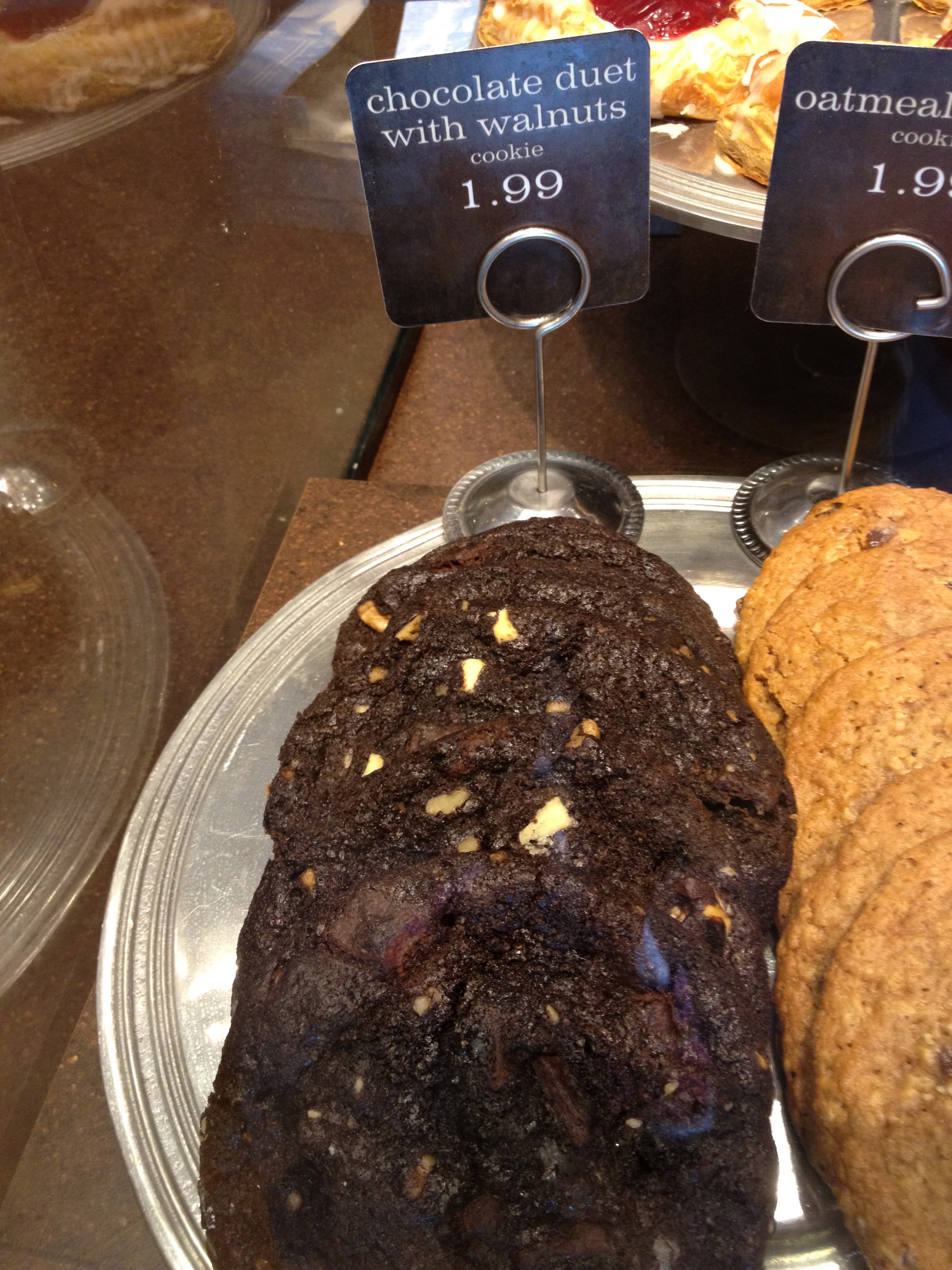
This morning, during our Saturday farmer's market and Panera Bread stopover, we visited with one of the four chef's that make their wonderfully fresh products each morning. Zoe shared a bit more about their oh so awesome Chocolate Duet with Walnuts Cookie. I'm uploading the short video interview with Zoe as I type. Should be available soon.
things looking UP at the Las Vegas Market

things looking UP at the Las Vegas Market
Although clearly not a record setter, yesterday was an amazingly good first day of the show. The summer market is never up to par with the Vegas winter market. But, we had a seemingly continual stream of traffic throughout the day. And more than a few new friends and fans. Great beginning to the Las Vegas summer market.
I really love this super cool World Market Center. Feel's like I'm walking into a canyon in the middle of this Las Vegas desert. We are located on the fifth floor of building B (above).

Las Vegas Market building B
The Trash Bag Epiphany
The Trash Bag Epiphany
by Susan Joyner, Gainesville Florida

On Tuesday, I was standing in an aisle at the grocery store, looking at all the choices for trash bags. I don't like the smelly ones. I guess the correct term would be "scented," but to me they are just smelly. I looked up and noticed a box of trash bags made from 65% recycled plastic. What an excellent idea! I often wonder what happens to all of the items put in recycling bins. Then I checked out the price. There were considerably fewer bags in the box, and they cost 10 cents more per bag. Sadly, I proceeded to buy my usual bags. But on the drive home, I started thinking more about trash bags and the reasoning that led to my decision.
I am concerned about the environment. I sort my trash and recycle what I can. I carry reusable bags when I go shopping. I avoid using those flimsy plastic bags for fresh fruit or vegetables. On the broad continuum of environmentally-friendly behavior, I like to think that I am somewhere in the middle. Obviously I can't even come close to the Johnson family whose solid trash for a year fits inside of a 1-liter mason jar. Honestly, I am still quite stunned that a family of four could even accomplish that feat. But I do what I can to make an effort to help the environment on a daily basis.
And
yet, the other day at the grocery store, I bought the trash bags that
were less expensive. Does that mean that I am failing my environmental
responsibilities? While some of you are nodding yes, I am hoping that
others are realizing that I am on a journey and have not yet arrived at
my destination.
Since
this trash bag-purchasing episode, I have begun to realize that every
single thing I choose to buy with my money and my reasons for choosing
it speak volumes about my real priorities in life. I have also realized
that even though I don't see all of the trash that is generated by our
society, the environmental impact is a concern of mine. Great enough
for me to spend a little extra money next time and buy the bags that are
made from recycled plastic. And so I take another step forward.
My
epiphany regarding trash bags has made me look more closely at my
reasons for purchasing items, and I have, therefore, become more aware
of using my money as a vote of support. What do your purchases say
about you? There's no judgment here. Journey on.
The Trash Bag Epiphany
Wild Handmade Soap

Wild Handmade Soap
Wild Handmade Soap
by Eunice Lim, Singapore
When was the last time you considered the ingredients of the soap you use every day?
The
skin is the largest organ in our body and it’s permeable, so, the
substances we apply to our skin are absorbed into our bloodstreams. With
that in mind, being conscious of the quality and origin of your soap is
important.
WILD sells handmade soap made of all natural herbs, grains, honey, goat milk and essential oils. On top of health benefits and healing properties, WILD is against animal testing and minimizes packaging, using biodegradable and recyclable materials whenever possible. The minimization of packaging also allows WILD to continue selling their body products at affordable prices. Instead of mass production, WILD sells their soaps online and from place to place. The quantity WILD manufactures depends on demand, so no compromise on quality is ever made.
I interviewed Rohana from WILD to find out more about her work with WILD.
EL: Rohana, why is selling natural, healthy soap your passion? And what does your work with WILD entail?
R:
I've always been health conscious and interested in natural products. I
love natural soaps and have been using natural products myself - so in a
way, this is an extension of my passion and what I love. We sell online
and at various fairs, and my work involves research, preparation of
product information and the sales and marketing of our products.
EL: Where are your handmade soaps made, by whom and how? Where do the natural ingredients come from?
R:
Our handmade soaps are made by someone we know who started doing this because
she has sensitive skin and can only use gentle products. Some of the
base oils are from Malaysia, while the rest of the ingredients including
essential oils come from all over the world.
EL:
Does WILD do international shipping? I am sure our readers overseas are
interested in getting their own fantastic bar of handmade soap.
R:Yes
we do, customers can order online and we could organize the delivery
and shipping for them. Some of the favorites include Geranium with Goat
Milk, Lavender and Geranium with Red Rice. My personal favorite is the
Geranium with Goat Milk.
You can find out more about WILD at their
website and make purchases. WILD ships
internationally. Products are suitable for sensitive skin and have been
known to relieve eczema. The natural ingredients come from sustainable
sources, so you can use your soap with complete ease of mind.
WILD's Facebook Page
Wild Handmade Soap
modern chair in solid oak v1.0
Modern chair in solid oak v1.0 This very simple modern oak chair is made from only four oak pieces. Although we rarely quarter saw lumber, because of the inefficiencies, the back is made of a (naturally cut) quarter sawn slab.

Modern chair in solid oak v1.0 This very simple modern oak chair is made from only four oak pieces. Although we rarely quarter saw lumber, because of the inefficiencies, the back is made of a (naturally cut) quarter sawn slab.
Art Nouveau Architecture in Brussels

Architecture in Brussels


Art Nouveau Architecture in Brussels
Saving the Artist and Creating a Feast for the Senses
by Richard Harris, Brussels
What do wild curves, crazy shapes, eye-popping mosaics, colorful Sgraffiti, stupendous wrought ironwork, intricate brickwork, and gorgeous stained glass all have in common? They are the striking elements of the Art Nouveau style of architecture which capture people’s imagination in an unforgettable way. They are also the product of a brilliantly successful campaign to save ancient arts and crafts from the onslaught of industrial assembly line efficiency.
Despite
the fact that many of Brussels’ Art Nouveau buildings were destroyed
between the mid-fifties and the mid-seventies, the city is still a
treasure trove with entire blocks built in the style. Instead of being
torn down, they are being lovingly restored—reinvigorating the various
artists and craftsmen trades. In fact, some of them are Unesco World
Heritage Sites.
A
reaction to Academic Art of the nineteenth century—the recycling of old
styles—the Art Nouveau movement was inspired by the natural forms and
structures of flowers, plants, and curved lines. Art Nouveau architects
tried to harmonize their works with the environment. Art Nouveau
furniture was designed to be in concert with the design of the whole
building.
That industrialization was especially acute in Belgium is illustrated by the fact that in the second half of the nineteenth century, Belgium—the size of the state of Maryland—was the third industrial power in the world. The artists and architects of the Art
Nouveau movement feared industrialization would lead to the extinction
of the age-old crafts that had been the pride of the country. In
resistance to mass production, Art Nouveau designers insisted on using
artisan-produced wrought iron, tiles, mosaics, paintings, Sgraffiti—a
technique of wall decor, produced by applying layers of tinted plaster
to a moistened surface—and lavish stained glass in and outside a
building. Art Nouveau buildings,
furniture, and furnishings, including the silverware, were handmade.
The result is a feast of the senses, a voyage of discovery in which each
house façade holds a myriad of carefully executed details, from the
front door’s lowly boot scraper to the magnificent bay window filled
with stained glass.
Every two years the Art Nouveau Biennial—the next in 2013—attracts thousands of tourists with special tours and exhibits. However, one need not wait for that! Many visitors come year-round to wander the Art Nouveau neighborhoods and visit the various houses that are now museums or everyday businesses such as cafés, floral shops, restaurants, government buildings, and even swimming pools.
Art Nouveau Architecture in Brussels
firewood or beautiful table for local community?
firewood or beautiful table for local community?
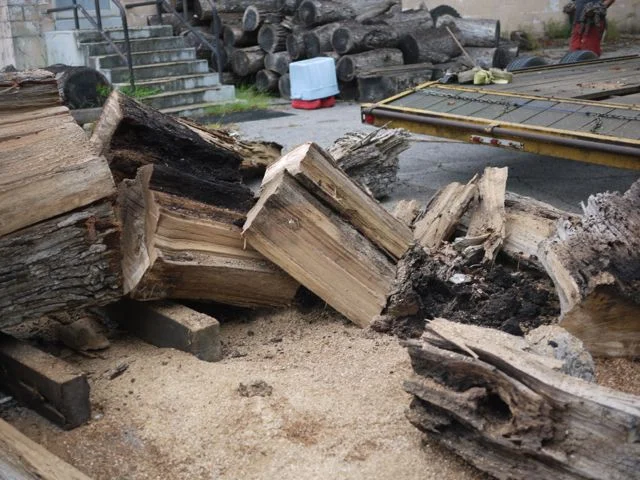
firewood or beautiful table for local community?
My guess is a little of both. I have to admit that, on first glance this heap of deadwood looks perfect for keeping us warm this winter.
Yesterday we used our 6000lb fork lift to remove this big log from the trailer, then cut a couple of three foot sections off the top end of it. I have to admit, when I first saw the way it was falling apart as we cut into it, I was disappointed.
Typically, a storm damaged tree is never considered for lumber or furniture. The damage and stresses that it incurred send it straight to the landfill. But since we start with logs, make our lumber, only for our own furniture needs, many times we can find amazing beauty here. And I have confidence that this will be no exception.
Later this morning, videographer Andrew Reed is planning to stop by the studio to document the first steps of our process of making this table for Phil Campbell.
firewood or beautiful table for local community?
New Website is Live this morning!
After a few weeks of mostly concentrated effort, the new site is live as of around 9:00 am cst this morning. Hope you enjoy the experience as much as we are.
There's still plenty more work to do to do in this garden of silicon. Lots of pages to add. Lots of blog posts to add back in. But for now, should you run into any glitches, please let me know - either through email; robinwadefurniture@mac.com or through the CONTACT link (below right).
Singapore Farms: Bollywood Veggies & Poison Ivy
Singapore Farms: Bollywood Veggies & Poison Ivy
By Eunice Lim, Singapore
When was the last time you ate fresh food? I mean, REALLY fresh food, not just food you got from the produce section of the supermarket. Here in Singapore, “Bollywood Veggies” takes its fresh food seriously; instead of shopping shelves and aisles, Bollywood’s customers are offered freshly-picked produce. A semi-retirement project of Ivy Singh and her husband Lim Ho Seng, Bollywood Veggies and the Poison Ivy Bistro located in it offers a whole new food experience. Named the Best LOHAS (Lifestyles of Health and Sustainability) Region by an American research company, Bollywood Veggies is not just any farm. This farm does not use any pesticides or fertilizers, maintaining its sustainability, eco-friendliness and organic produce.
The great variety of vegetables, fruits and flowers growing on the farm is truly amazing -- Starfruits, Hibiscus, Figs, Papayas, Laksa Leaves, Pandan Leaves, Sugarcane, Rice, Chilli and so much more. The bright colours of the fruits and flowers are striking amidst the greenery of the farm. None of the food here comes to you on a shelf or in a refrigerator. Instead, they retain their original form and grow on trees, vines and bushes. Farms like Bollywood Veggies reawaken our connection to the food we eat and its natural origins.
While you are not allowed to pluck the fruits or dig up the vegetables, you are welcome to visit the Poison Ivy Bistro which is situated within the farm. Here is where you can taste the goodness of the farm’s produce. Freshly collected from the farm itself, the food on your table comes directly from the farm around you. The curry leaves in your Warrior’s Chicken Curry comes from the curry leaf patch a mere few metres away. The chilli on your otah comes from the chilli plant, also a stone’s throw away. A cup of iced fig tea is guaranteed to be available: the evidence of this being the abundance of figs hanging on the trees around you. Food simply does not get fresher than this.
The most popular produce of Bollywood Veggies is banana cake, freshly baked using the bananas grown on the farm. A full loaf of the banana cake costs you $10. Forget banana flavoring, the Bollywood Veggies Banana Cake comes with chunks of banana slices in it, a delightful proof of its wholesome freshness.
It is heartening to know there is a place like this in Singapore, reminding us of what freshness really means, allowing us to stop and ponder the importance of knowing exactly where and what goes into the food we eat.
Singapore Farms: Bollywood Veggies & Poison Ivy
We're back in the Robb Report - well sort of
We were already getting all geared up to celebrate Independence Day, but now we have another big reason to party. We are back in the Robb Report - well sort of. After being featured last September, it never occurred to us that we might be back in the supercool, super luxurious Robb Report - particularly not within a year! But here we are.

We were already getting all geared up to celebrate Independence Day, but now we have another big reason to party. We are back in the Robb Report - well sort of. After being featured last September, it never occurred to us that we might be back in the supercool, super luxurious Robb Report - particularly not within a year! But here we are.
Linda was just looking through the July/August issue of the Robb Report's "Exceptional Properties" and did a triple take. A couple of pieces of our furniture that were showcased at the beautiful NAHB New American Home in Winter Park are sitting pretty front and center smack dab in the middle of three photos of this issue. Now, to be honest, this isn't a feature of Robin Wade Furniture. I couldn't even find a mention of us - that is - with the exception of these three photographs.
The feature was of another American Made icon, Timberlake Cabinetry of Winchester Virginia. Just a little more to celebrate this Independence Day

The feature was of another American Made icon, Timberlake Cabinetry of Winchester Virginia. Just a little more to celebrate this Independence Day
