

Permaculture - Permanent Culture in Lilongwe
 Permaculture - Permanent Culture in Lilongwe
by Lauren Kent, Johannesburg
Let me paint a scenario for you: a tiny country, with a lake that takes up one third of the land; a country that has just had almost half of its foreign aid removed; a country that has no foreign currency and, thus, no fuel; a country that, according to her citizens and people whom have visited the country, is one of the most peaceful on the African continent; a country that in 2011, despite this visage of peace, had fairly violent anti-government riots . It is in this country that a small farm, just outside of the capital city, Lilongwe, is attempting something revolutionary.
The workers on this farm have one goal: to make Malawi a permaculture country.
Malawi is a tiny country in Southeast Africa. Also called the Warm Heart of Africa (her tourism tagline), Malawi is a very poor country, where for the majority of the year people live off of nothing except maize meal.
This is what Nature’s Gift Permaculture Centre wishes to change.
Permaculture, in a nutshell, is just this – permanent culture. The concept has three fundamental principles at its core: earth care, human care, surplus share. Caring for the earth means using its resources wisely, observing how the natural environment works and then using these observations to improve our farming methods. Through these actions we hope to preserve the earth for a long time. By caring for fellow people, permaculture practitioners are ensuring that they are in a state to care for the earth, and each other. Surplus share has many different meanings: it could refer to sharing extra food with others who do not have as much, sharing time to help others, using plant trimmings and scraps in compost heaps to return nutrients to the soil, or sharing knowledge with others so that people may also benefit from the principles of permaculture.
It was on this farm in Lilongwe that I first learnt about permaculture. In the four weeks that I spent there, I only just grazed the surface of this concept. But what was glaringly obvious was this: the answer to the hunger, poverty, and, yes, even the lack of fuel in the country was, and still is, permaculture.
According to Eston (who works at the farm), and a Malawian environmental consultant whom I met in the city, Malawians are creatures of habit. In other words, generation after generation, people have not changed their planting, harvesting and eating habits. Malawians seem to believe that maize is their answer to everything. Maize can even show status- if it is more processed, the family has the money to mill their food twice or even three times. Unfortunately, food processing lowers the nutritional value of the food, which is quite a sacrifice to make in order to look rich.
Similarly, I was told that Malawians do not want to plant what grows locally. Their view is that the best plants come from imported, genetically-modified seeds. Therefore, many Malawians, it seems, rely on seed handouts. Eston just could not understand how Malawians could ignore the richness in an abundance of local, hardy, food plant seeds, which would sustain a family and sustain the land. Farming methods that adapt to each region of the country’s climate and way of life could change famine and low crop variety to abundant food year-round.
Eston’s view is that Malawi is poor because they always feel the need to spend money to get food. He wants to change that idea – people can plant local foods (cowpeas, green leafy vegetables, tropical fruits), keep a few seeds, and replant them. They could even plant foreign foods! Saving the seeds makes for free, available food plants that suit the specific climate of the country.
Nature’s Gift is even tackling the fuel situation. The farm produce is delivered using bicycle taxis. Perhaps most importantly, the farm is in the process of growing large amounts of Jatropha bushes. These bushes yield a seed that makes a very good petrol replacement.
In the planning pipelines, when I left the farm, was a bee farm, and a proper medicinal garden. The permaculture way of life has not been confined only to the farm. The ideas and practices had already begun filtering into nearby villages. The workers on the farm residing in villages away from Lilongwe had started building permaculture style gardens and teaching their neighbors. This is surplus share, the spreading of knowledge.
As for a solution to the anti-government riots - well-fed and healthy people don’t have much to riot about. well, hungry and frustrated people are not a happy and peaceful people.
Permaculture - Permanent Culture in Lilongwe
Zinneke: an exploration of a remarkable sustainable contemporary event
 Zinneke: an exploration of a remarkable sustainable contemporary event
by Richard Harris, Brussels
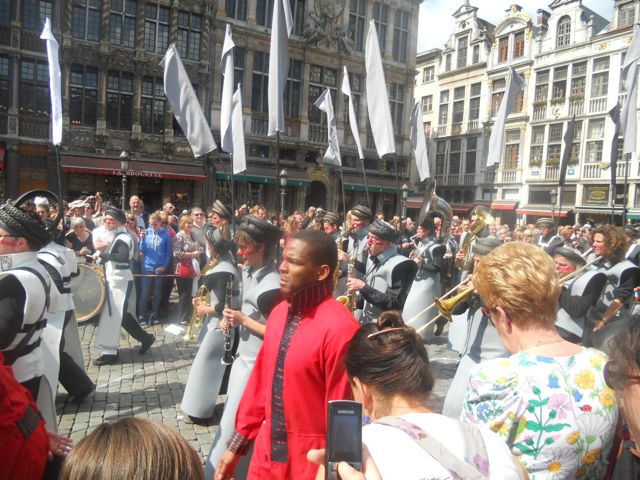
Zinneke: visually spectacular and lots of fun! It’s a biennial parade based fully in the rich and still very vibrant Belgian carnival and parade tradition with giants, people on stilts, drum batteries, clowns, ribald humor, etc. It simultaneously manages to be intensely modern with vertiginous multiculturalism, ecological and democratic foundations, and performance art. It is the result of an intense collaboration between inhabitants, associations, schools and artists from the different neighborhoods of Brussels and beyond. Zinneke is a collective creation, a walking extravaganza which presents itself both as an expression of and an experiment in living together in diversity in the city.
Zinneke is the Brusseleir word for “mutt”, and is what the people of Brussels have always been, at the 
In 2000, as part of the European City of Culture festivities, the parade was born. One of the purposes was to develop creative workshops throughout the city, especially in disadvantaged areas. Each parade has a theme and is developed over two years. The process starts with the election of a theme; two years ago it was “The Table”, in celebration of eating and socializing; two years before that it was “Water”. This time, the 900 suggestions were reduced to three finalists: “Desire”, “Disorder” and “Fragility”. The winner was “Disorder”. Once the theme is set, the 2,000 participants who constitute the 22 Zinnodes (or teams) start brainstorming how they are going to interpret the theme visually and what spin they are going to put on it.The Zinnodes then design, build or choreograph their concept and 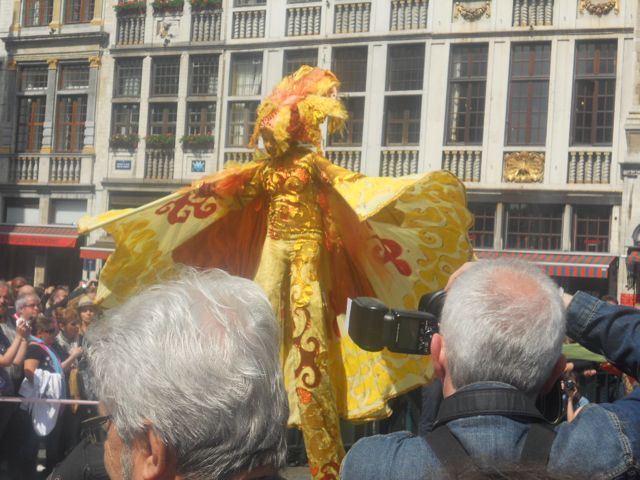
The creative process of Zinneke embodies sustainability and ecological concerns. Though there are some traditional musical instruments, most are constructed and everything must be human-powered. There is no electric amplification of the music and no motors or fuel are used in the parade. A premium is put on using recycled materials and objects. Most Zinnodes design their presentation around such ideas as limiting the carbon footprint, intercultural communication, a green future, the power of art to help create a better world, and local sourcing. But, of course, in fine Brussels tradition these 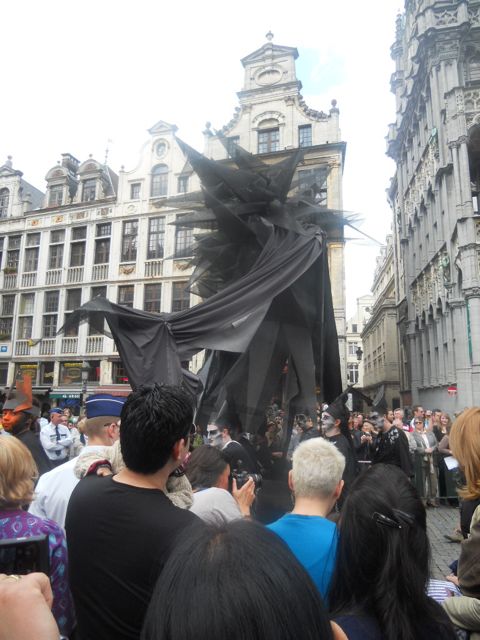
Children are important participants. Not only are children exposed to art and the creative process, but also to art and performance as a team activity. So often the only team activity children are exposed to and encouraged to participate in is athletics, which presupposes competition. Here we have teams without the struggle, though, naturally, everyone wants their Zinnode to shine. Also the inclusion is broad; in addition to the many cultural groups, special populations are involved.
At the end of the parade, there is a surprise send-off. Two years ago, all the participants leapt into the air at once; this year it was a fireworks display. Then, everyone, participant and spectator together, celebrates into the wee hours.
There are a staggering 700 public events in Brussels per year (an average of 2 per day) which is one of the things that makes it so much fun to live here, and this is one of the best.
Zinneke: an exploration of a remarkable sustainable contemporary event
commercial hydroponics garden right down the road
 commercial hydroponics garden right down the road
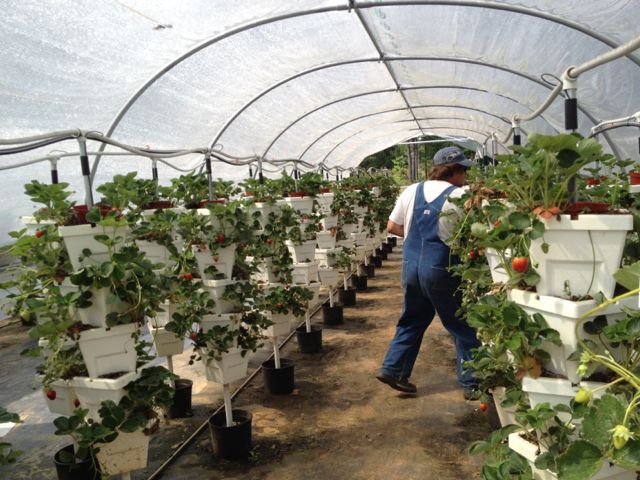
I think the only thing better than fresh fruits and vegetables might be if they are grown right down the road, and they're organic. Yesterday's visit to Shamrock Farms in Waterloo Alabama was quite amazing. These country boys really have their stuff together. Using the same quite simple, but patented technology that's seen at Epcot and was developed through our Space program.
Possibly the most beautiful produce I've ever seen. These vertical hydroponics drip system is quite efficient. Uses very little water. And uses one fifth the land. Quite ingenious.
I just couldn't stand it. They'll be helping me install a little two station system on my back deck tomorrow. Can't wait!
commercial hydroponics garden right down the road
Shiitake mushrooms & oak logs in Alabama


Shiitake mushrooms & oak logs in Alabama
Amazing what you can find if you keep your eyes open. Linda and I have been enjoying Shamrock Farms (Waterloo Alabama) organic produce for several seasons now. Their amazing Spring blueberries were the original draw at our local farmer's market. Then we continued to be drawn in with fresh, organic delicacies each market. This year's we've been blown away by their shiitake mushrooms. And have just been amazed that they were producing them here in Alabama.
Yesterday, my long time Bub (Bobby Harris) and I took what should have been a 20 minute drive north through the beautiful countryside to visit Shamrock's organic, hydroponic gardens. And what a treat it was. This Alabama country crew really has their stuff together. Using the best patented hydroponic systems, originally developed by our space initiatives? to organically water and nourish their beautiful crop. -- More about this on a future post.
But we were mesmerized by their over the top shiitake mushroom production. This is all quite technical that I'm not the one to explain. But the mushroom spores (family origin Japanese) are sourced from Washington State University. They drill dozens/hundreds?? of tiny holes in the perfectly cured oak limbs, hydrate and time it all perfectly, and somehow eventually end up with fifteen years production of shiitake mushrooms from each limb.
They will even sell you an oak log ($100) already producing shiitake's! Just set it under your kitchen sink, vertically in a tub of water. (still thinking about this part)
Shiitake mushrooms & oak logs in Alabama
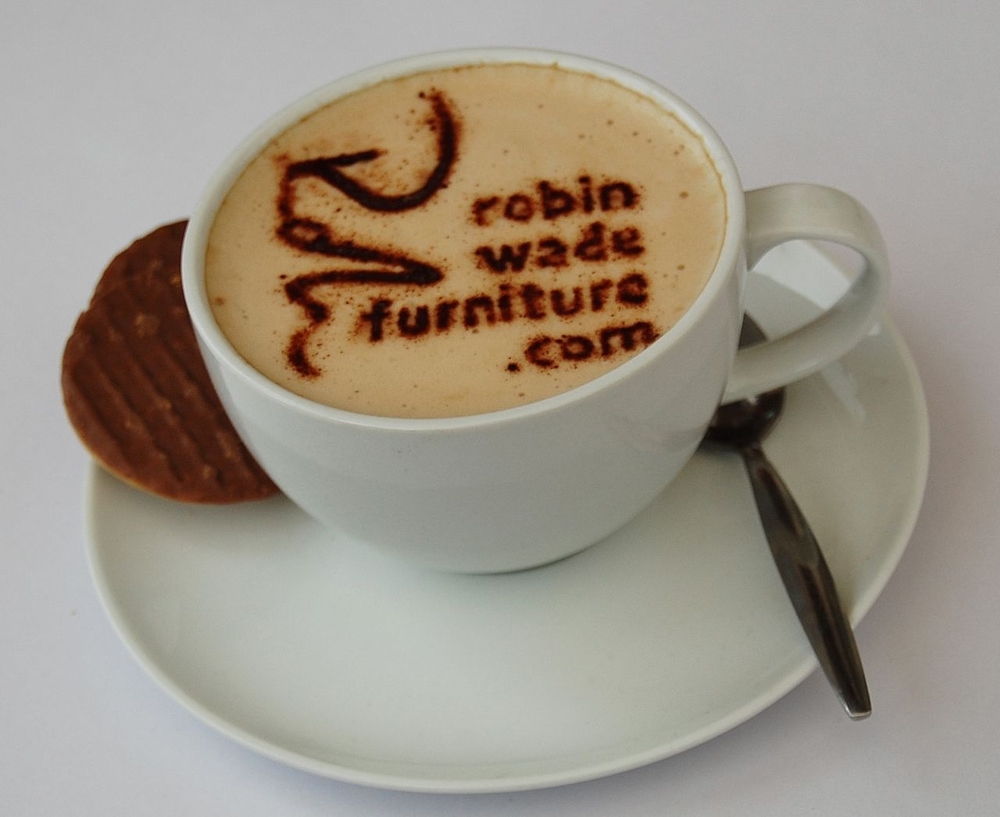
Nice surprise in this morning's cappuccino
Cramer Children's Center - Florence Alabama
 Cramer Children's Center - Florence Alabama
The Cramer Children's Center had an enlightening open house yesterday afternoon. Amazing how much good Randy Parker and his small organization are doing. Housing almost 200 hundred last year alone.
It was just a year ago that the massive old oak that lived almost a century shading this location, was downed by the killer tornadoes that ravaged the country. I'm happy to report that slabs from this tree are cut and have begun their slow air drying process. With time, I'm looking forward to working to building a beautiful piece of furniture from this tree, and have promised to donate it to the center - in an effort raise funds and awareness.
Cramer Children's Center - Florence Alabama
Vitamin Green and Sustainable Design
 Vitamin Green and Sustainable Design
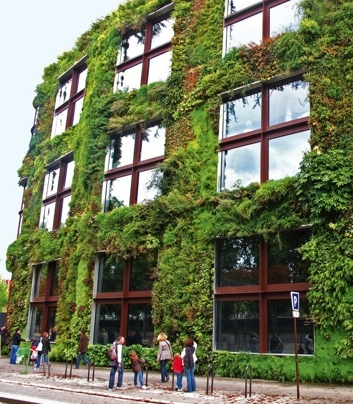
In these urgent times of environmental concerns, Vitamin Green, published by Phaidon, gives us excellent examples of sustainable design. Vitamin Green defines itself as a ‘visual definition of sustainability in design.’ Through striking images, take a look at what Vitamin Green has to offer. A vertical garden, The Living Wall at the Musee du Quai Branly by Patrick Blanc with Gilles Clement and Ateliers Jean Nouvel, Harmonia 57 by Triptyque, lightbulbs called Plumen 001 by Samuel Wilkinson, a non electric incubator, Embrace Infant Warmer, and a carbon neutral city, Masdar City by Foster + Partners in the UAE.
Vitamin Green and Sustainable Design
Santa Barbara Airport
 Santa Barbara Airport
The newish Santa Barbara is just beautiful. All of this wonderful Spanish influenced architecture in Santa Barbara reminds me of the South's beautiful/historic St. Augustine.
I think I'm already falling for Santa Barbara (and I just landed!)
Centiva leading with Green @ HDexpo
 Centiva leading with Green @ HDexpo
So cool that one of the leaders in the green movement in this Hospitality arena is Alabama's own Centiva. I always enjoy visiting with John Bonney of Centiva at these Hospitality shows around the country. Looks like he only lives a half mile or so upstream from Linda and I. We'll have to paddle over before long. - Obviously our paths aren't crossing in little Florence, Alabama.
Centiva leading with Green @ HDexpo
HD Expo Vegas 2012 looking strong yesterday
 HD Expo Vegas 2012
The first day of the HD Expo was busteling with activity. Buyers from around the world seemed to be swarming. This hospitality side of the industry was looking quite strong.
The American Made niche, with a few nice exceptions, didn't seem to be making any significan headway. But the green/environmental focus was everywhere. Great to see that this important model apparently has quite a foothold.
HD Expo Vegas 2012
Wooden Furniture: Appreciation or Appropriation?
Wooden Furniture: Appreciation or Appropriation?
By J.J. Fellows
Is our appreciation of forests an explanation for why we love wood furniture?
At first, the answer to this seems pretty straight-forward. Wooden furniture is often prized because it is natural and rustic. So it seems quite clear that a love of wood and a love of forests might very well have something in common; a love of natural as opposed to artificial beauty. But not everyone would readily agree with this idea. Holmes Rolston III, an environmental ethicist, argues that our appreciation of nature cannot be compared to an appreciation of wooden artifacts. In fact, the very act of taking something from the forest, like a piece of driftwood, and putting it on display for appreciation undermines our ability to meet nature on its own terms, or to accept it for itself.
If we make the forest over into an object of our aesthetic fancy, as we might find a piece of driftwood and display it for its form and curve, then we project onto it our craft and criteria, yet fail to see what is there. (160)
Rolston's objection amounts to a claim of appropriation. If we take materials from nature and use them for our own purposes, we are not accepting nature for itself. Instead, we are projecting our own ideals onto the object. Because of this projection, we miss the opportunity to see the driftwood as it really is (perhaps as the remains of a once-living tree whose lifespan dwarfs our own, or as the result of a powerful body of water slowly petrifying and smoothing these remains, for example). Friends of mine display a piece of driftwood that looked a bit like a lounging man in their back yard. They have accentuated the resemblance by adding little eyes in what would be the man's face. Rolston would likely label this a stark example of our tendency to anthropomorphize nature.
Rolston condemns such acts as an inability to see nature for what it is. But this condemnation seems unfair to me. We have a tension with nature. We have tried to separate ourselves from nature as much as possible—yet humans are creatures of nature, just as other mammals are. Wooden sculptures and wooden furniture seem to exemplify this tension. They illustrate our efforts to both bend nature to our will and to appreciate it for itself. If this is the case, then a driftwood sculpture cannot simply be an anthropomorphizing of nature. It is, rather, a visual exploration of this tension.
When I look at a well-crafted piece of wood furniture I feel a sense of respect. I feel that some gifted artist has attempted to overcome this tension between nature and civilization, to unify opposites into something beautiful. I imagine that these artists want nature to speak for itself. But they also want it to speak for them. To spread their message that this tension can be overcome. I think that when we go out and spend time in nature, we are blurring the boundary between the forest and civilization. So, when we bring finely crafted wood pieces into our homes, we are doing the same. This is not appropriation, or at least not necessarily so. Wood furniture and sculptures can, themselves, be a way of appreciating nature, and of exploring this tension. What matters is our awareness and attitude towards them.
Wooden Furniture: Appreciation or Appropriation?
Sustainability as Keepsakes
Sustainability as Keepsakes
by J.J. Fellows
Promoting sustainability by passing down furniture
A while back I wrote an article on how to promote sustainability in our consumer practices (to read that article, go here). I wrote that article while sitting at my grandmother's desk, one of many things in my house that belonged to someone else before it belonged to me. At first, the reason for the abundance of hand-me-down furniture that peppers my house was simple: I was a poor student. But over time, these hand-me-downs served as anchors to my family. They provided me with ways to revisit those I had lost. They allowed me to keep those I'd left behind as I moved across the country in my heart. In short, these pieces of furniture became more than simply places to sit, sleep, or work. They became keepsakes.
In conducting the research for my sustainability article, I realized that reusing old furniture and consuming less can be a way to promote sustainability. Less consumption means less production which, in turn, results in less harvesting of raw material and burning of fossil fuels. It also results in less waste in landfills. But I admit that when I look around my home, I did not reuse these pieces of furniture with any goal of sustainability in mind. I kept them because of what they do for me. These old pieces of furniture connect me to my roots, and make my house feel like a home.
Of course, this is not the only—or even most popular—way to design a home's interior, and it's entirely subjective. If you don't know the story of my grandma's desk, my father's wooden chest, or my neighbor's  rocking chair, then you will likely not feel anchored and connected in the way I do. You may not find my home to be aesthetically pleasing at all. So, I wondered, how does my home compare to modernist aesthetic values? How does it stack up against one of the best examples of modernist interior design, the Glass House? Was I sacrificing beauty for memories? And, if so, was the cost worth it? Once again, I did some research. To read more about Modern Aesthetics and my grandma's hand-me-down desk, follow the link for A Discussion of Beauty and Comfort.
Sustainability as Keepsakes
You don't have to be Jane Goodall
 You don't have to be Jane Goodall
What would it take for you to help the environment? Do you have to be someone rich, famous, devoted or smart? Of course not. You don't have to be Mother Teresa, Einstein or Jane Goodall. You don't have to be them...
See a few thoughts from our teen intern Senghee, who attends Gandhi Memorial International School in Jakarta.
You don't have to be Jane Goodall
HD Expo Las Vegas
 HD Expo Las Vegas
Leaving tomorrow for the big hospitality show of the year, HD Expo in Las Vegas. I'm intrigued with the idea of marketing to high end boutique hotels. I can see my massive organic coffee tables in the lobbies of the top modern boutique hotels. - But it's just in my head at the moment. Will be walking the show again this year to see if I bump into "it".
if you will be attending the HD Expo, and would like to meet for a coffee or to talk tables, I'll only be available Tuesday May 15. You can email me if you'd like to make an appointment. robinwadefurniture@mac.com
HD Expo Las Vegas
Shoutout to J.J. Fellows
Our new contributors generally jump at the opportunity to write about subject matter that they are passionate about, but enticing them to write about themselves has been like pulling teeth. J.J's skills in thoughtful research and writing are amazing, and so appreciated. She's a wonderful role model for the future of our program. I'll be moving her bio over to a new contributor bio page soon, but for now, I just wanted to say thank you J.J.! p.s. J.J. Any chance of a video of your poi spinning??

When not glued to the keyboard, she enjoys hiking, yoga, and spinning poi. For more information visit her website at http://sites.google.com/site/jjfellows/home, or follow her on Google+.
MLK Dedication in Bordeaux
 photo by by Vanessa MerinaMLK Dedication in Bordeaux
by Vanessa Merina, Bordeaux
"We must learn to live together as brothers or perish together as fools."
- Martin Luther King, Jr. In honor of Martin Luther King Jr.'s contributions and to underscore French-American relations, the city of Bordeaux recently dedicated part of its waterfront to MLK.
I arrived the afternoon of the dedication just as a crowd was gathering along the river. I recognized the mayor, Alain Juppé, along with folks from the American consulate. There were also a number of community leaders as well as people who’d wandered up, drawn by the activity.
At the appointed time, we all walked along the river and took our places beside several small tents. The ceremony was simple and moving: students from a nearby high school read parts of King’s speeches and both the mayor and a consulate rep spoke, underscoring King’s work toward equality, civil rights and diversity.
I saw a guy handing out flyers and took one. It featured a photo from March 25, 1965 of civil rights marchers massing together on the fifth day of a voter registration march. They were readying, the caption said, to start a three-mile walk to Montgomery, Alabama.
As the speakers continued, I closed my eyes and listened. I’d moved to France in January with a 1-year renewable visitor visa after my boyfriend got a postdoc in medical physics. Since arriving, I’d struggled with the competing pulls of France and home and the challenges of living in a new culture.
The more I listened, however, the more I began to feel at peace with our decision to uproot. Here was a remarkable individual—MLK—whose work was valued by two differing cultures. King, who’d gathered together a range of people to live together as brothers. King, who celebrated diversity in the midst of working toward a common good.
After the ceremony, I walked home through the streets of Bordeaux as though seeing them for the first time: their chatting residents, their crowded bakeries and shops. It was a quiet shift—to finally feel welcomed as part of my adopted city.
MLK Dedication in Bordeaux
Planing Oak Slabs today
 Planing Oak Slabs today
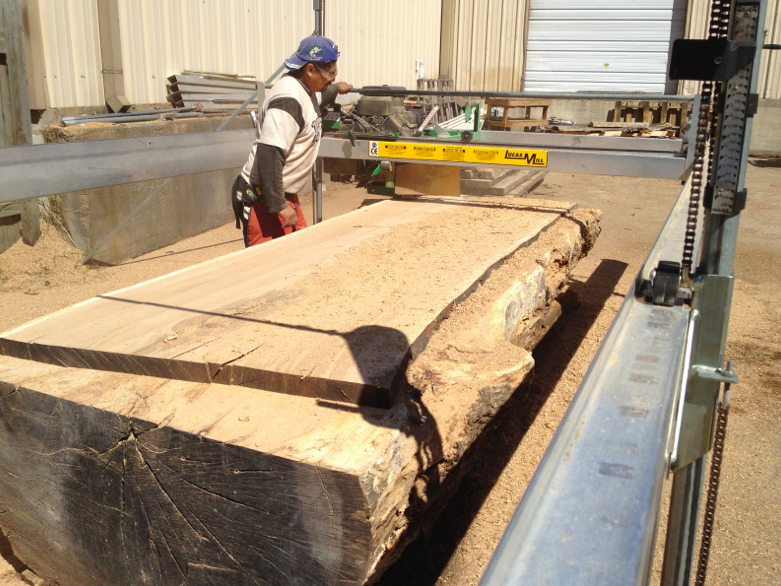
These beautiful massive oak slabs were calling to be planed on this crisp blue sky day. The slabs were three years air drying before sent to the kiln for their final cure.
These biguns are almost too heavy to turn over for planing the second side.